
What Sets These Two Formats Apart
Peer support groups — whether online or in-person — are built on the same core idea: people with shared experiences coming together to offer mutual understanding and encouragement. If you're new to this concept, our article on what peer support groups are and how they work offers a solid foundation before exploring format differences.
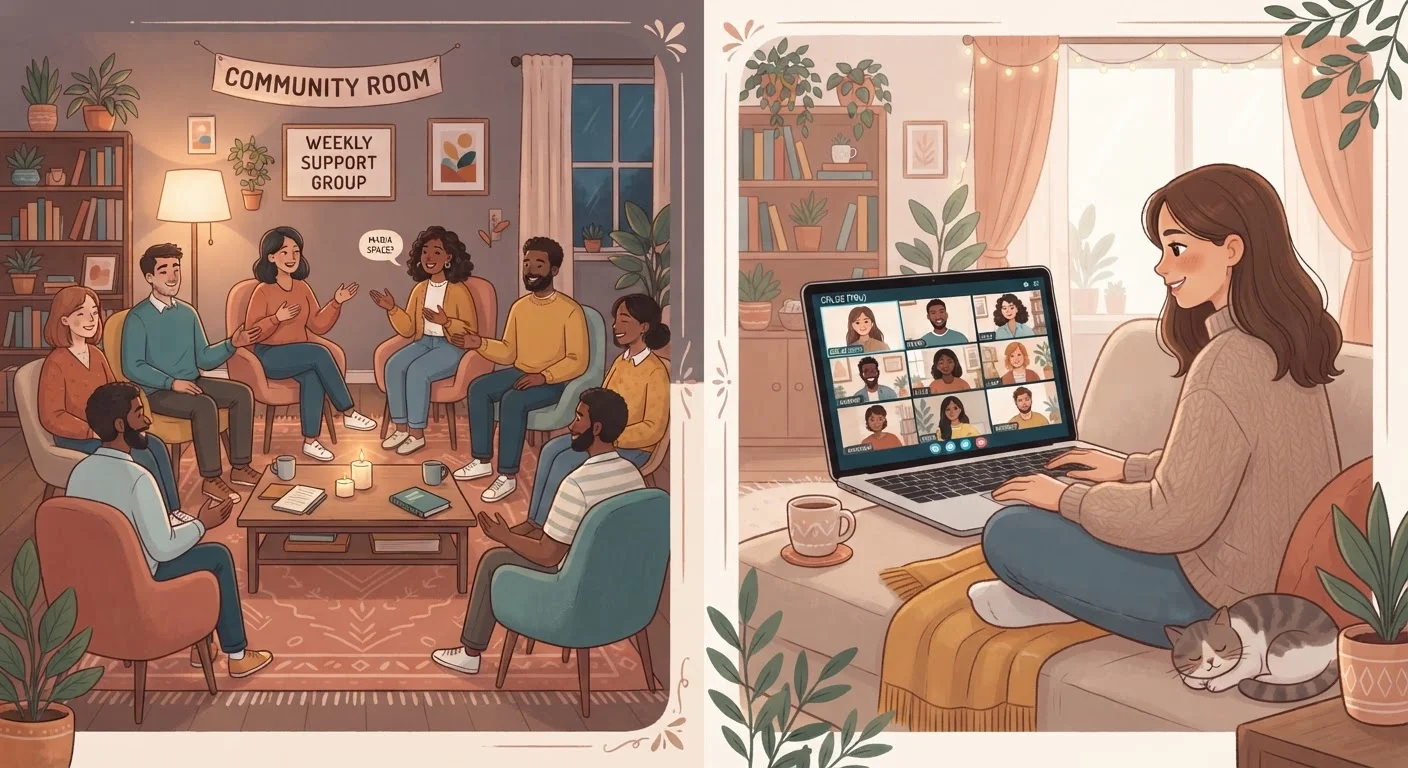
The key distinction between virtual and face-to-face formats lies in how connection is experienced, not whether it exists. Online groups use video conferencing, chat platforms, or dedicated apps. In-person groups gather in community centers, libraries, places of worship, or healthcare settings. Each format shapes participation, intimacy, and accessibility in distinct ways.
| Criterion | Online Peer Support | In-Person Peer Support |
|---|---|---|
| Accessibility | Available anywhere with internet | Limited to local geography |
| Scheduling flexibility | Often asynchronous or varied times | Fixed meeting times and locations |
| Sense of connection | Can feel less immediate | Enhanced by physical presence |
| Privacy at home | Not guaranteed; requires quiet space | Neutral venue provides separation |
| Barrier to first attendance | Lower — join from home | Higher — requires travel and commitment |
| Group variety | Wide range of niche communities | Limited to what's available locally |
| Technical requirements | Device, internet, and app needed | No technology required |
The Case for Online Peer Support
Online peer support has expanded rapidly, making it easier than ever to find a group aligned with your specific needs — whether that's grief, anxiety, chronic illness, or something else entirely. The most significant advantage is accessibility: you can join from anywhere with an internet connection, at times that fit your life.
For people managing social anxiety, agoraphobia, or physical health limitations, participating from a familiar environment can reduce the friction of showing up. There's also a degree of control — you can mute, step away, or type rather than speak, which many find less intimidating at first.
75%
Adults who prefer flexible scheduling for support
A SAMHSA report noted that scheduling flexibility is among the top-cited barriers to consistent participation in mental health support services.
2x
Increase in online peer support group participation
Mental Health America observed roughly a doubling in online peer community engagement following the widespread shift to virtual services in recent years.
That said, online formats come with real limitations. Screen fatigue is a genuine challenge, and technical difficulties can disrupt the flow of vulnerable conversations. Privacy at home isn't guaranteed — not everyone has a quiet space free from interruptions. These factors are worth weighing honestly. For a broader look at how digital formats compare in therapeutic contexts, see our piece on in-person vs. online therapy trade-offs.
The Case for In-Person Peer Support
There's something difficult to replicate about sharing physical space with others who understand your experience. In-person groups offer nonverbal richness — a reassuring nod, sustained eye contact, or simply sitting in a room and not feeling alone. Research in social psychology consistently points to the value of physical co-presence in building trust and reducing feelings of isolation.
In-person settings also tend to support ritual and routine. Traveling to a fixed location, even a short distance, creates a boundary between everyday life and the group experience — one that many participants find grounding. Over time, familiar faces and shared rituals deepen relationships in ways that can extend beyond the meeting itself.
The trade-offs are real, though. Geographic limits, transportation barriers, and fixed schedules can make consistent attendance difficult. First-time attendance can also feel more daunting than clicking a link. Our pre-session readiness checklist can help ease that first-time anxiety for either format.
Not Sure Which Format to Try First?
It's completely normal to feel uncertain. Many people find it helpful to try a single online session first — it's lower stakes and lets you experience peer support without the pressure of traveling to an unfamiliar place. From there, you can decide whether to continue online or explore an in-person option. There's no single right answer, and switching formats later is always an option. See our overview of peer support vs. professional therapy to further clarify what kind of support fits your current needs.
Making the Right Choice for You
Neither format is objectively superior — the right fit depends on your individual circumstances, preferences, and what you're hoping to get from peer support. It's worth asking yourself: Do I feel more comfortable opening up face-to-face or behind a screen? Do I have reliable internet access and a private space at home? Is there an in-person group near me that addresses my specific needs?
Some people try both and alternate depending on life circumstances. Others start online and transition to in-person as their confidence grows. What matters most is finding a format that makes showing up feel possible and worthwhile.
Remember, peer support works alongside — not instead of — professional care when that's needed. Our article on how peer support complements professional care explores how these two forms of support can work together. When you're ready to find a group, guidance on finding a peer support group that fits you can help you take the next step.
This article is for general informational purposes only and is not a substitute for professional mental health advice, diagnosis, or treatment. If you are experiencing a mental health crisis or need personalized guidance, please reach out to a qualified healthcare professional.