
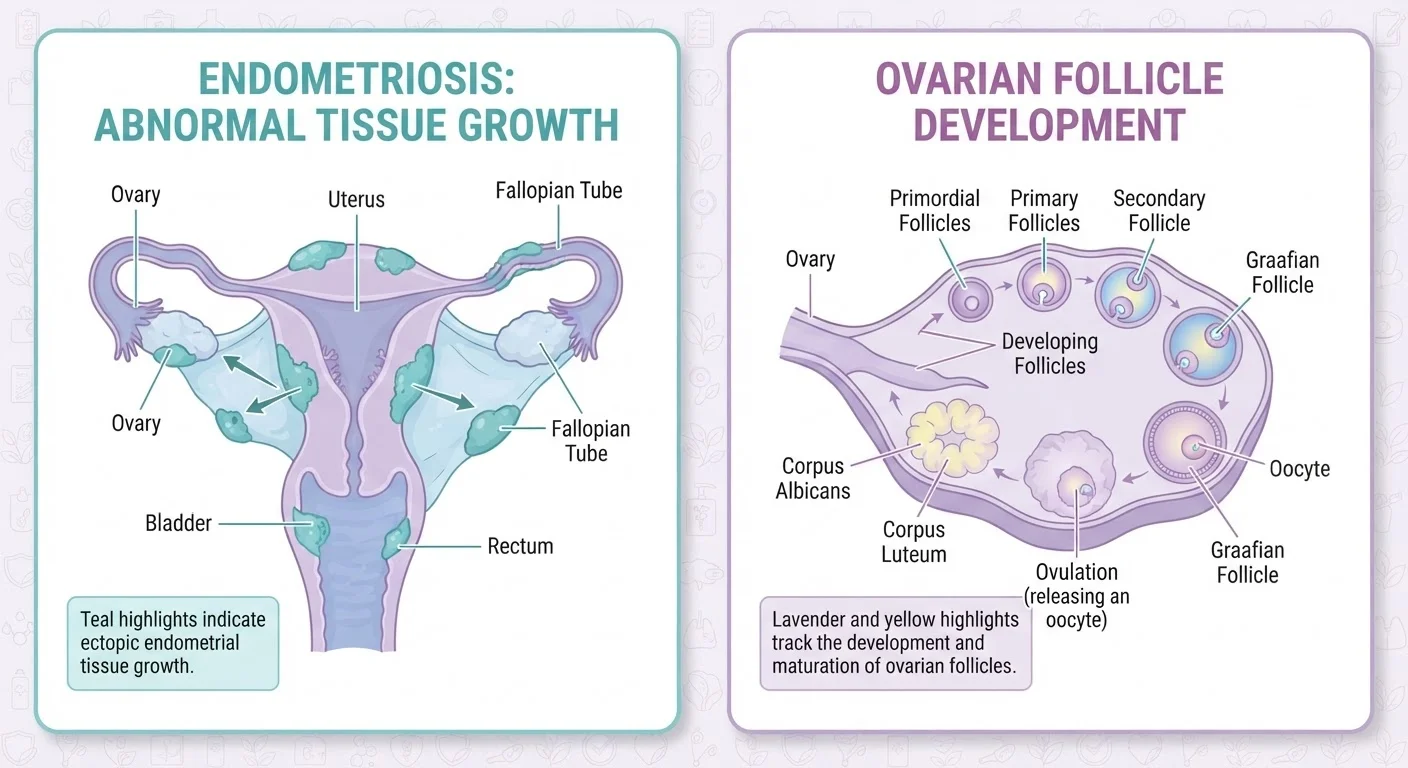
What Each Condition Actually Is
Endometriosis and PCOS are two of the most frequently discussed reproductive health conditions in women's medicine — yet they are often conflated, partly because both can disrupt menstrual cycles and affect fertility. Understanding what makes each condition distinct starts with their core biology.
Endometriosis occurs when tissue that resembles the uterine lining (the endometrium) grows in locations outside the uterus — most commonly on the ovaries, fallopian tubes, and the tissue lining the pelvis. This misplaced tissue responds to hormonal cycles just like normal uterine lining: it thickens, breaks down, and bleeds. But because there's no way for this blood to exit the body, it causes inflammation, scarring, and adhesions (bands of fibrous tissue). The result is often significant pain, particularly around menstruation.
Polycystic Ovary Syndrome (PCOS) is a hormonal and metabolic disorder. Its defining features include elevated levels of androgens (often called "male hormones," though all women produce them), irregular or absent ovulation, and — in many but not all cases — small fluid-filled follicles visible on the ovaries via ultrasound. PCOS is closely associated with insulin resistance in a substantial proportion of people who have it, which contributes to its metabolic effects. For a fuller picture of how PCOS affects hormone levels, see our plain-language PCOS hormonal overview.
In short: endometriosis is a condition of abnormal tissue growth and inflammation; PCOS is primarily a hormonal and ovulatory disorder. They are mechanically very different.
Symptoms, Diagnosis, and Who They Affect
Both conditions can cause menstrual irregularities, which is one reason they are sometimes confused. But their symptom profiles differ in meaningful ways.
| Criterion | Endometriosis | PCOS |
|---|---|---|
| Core mechanism | Abnormal tissue growth, inflammation | Hormonal imbalance, ovulatory dysfunction |
| Menstrual pattern | Often heavy, very painful periods | Irregular, infrequent, or absent periods |
| Pelvic pain | Common and often severe | Not a primary feature |
| Androgen excess | Not a defining feature | Central diagnostic criterion |
| Metabolic effects | Generally limited | Common (insulin resistance, weight changes) |
| Fertility impact | Scarring can block tubes or affect ovaries | Irregular ovulation reduces conception chances |
| Diagnosis method | Laparoscopy (surgical confirmation) | Blood tests, ultrasound, clinical signs |
| Prevalence estimate | Affects ~10% of reproductive-age women | Affects ~6–12% of reproductive-age women |
Diagnosing endometriosis is notoriously difficult — the average time from symptom onset to confirmed diagnosis has historically been several years, partly because symptoms vary widely and there is no simple blood test. The gold standard remains laparoscopy, a minor surgical procedure that allows a clinician to visually confirm and biopsy tissue. Imaging such as transvaginal ultrasound or MRI may suggest the condition but cannot definitively confirm it.
PCOS diagnosis follows criteria that typically require at least two of three features: irregular ovulation, elevated androgens (measured via blood tests or clinical signs such as excess hair growth), and polycystic-appearing ovaries on ultrasound. No single test is definitive. It's worth noting that PCOS basics are frequently misunderstood, and the name itself is somewhat misleading — not everyone with PCOS has visible cysts, and visible follicles alone don't equal a diagnosis.
7–10 years
Average endometriosis diagnosis delay
Research published in reproductive medicine journals consistently finds that women wait an average of 7–10 years from symptom onset to an endometriosis diagnosis.
~70%
PCOS cases with insulin resistance
Studies suggest that approximately 65–70% of women with PCOS show some degree of insulin resistance, according to endocrinology research literature.
Up to 50%
Endometriosis patients with fertility challenges
Estimates from reproductive medicine indicate that up to 50% of women with endometriosis may experience some degree of difficulty conceiving, though outcomes vary widely.
It's also worth acknowledging that online health information can make it easy to misattribute symptoms. Our piece on common hormonal health misreadings outlines why professional evaluation matters.
This article is for general informational purposes only and does not constitute medical advice. If you are experiencing symptoms, please consult a qualified healthcare provider for evaluation and guidance.