
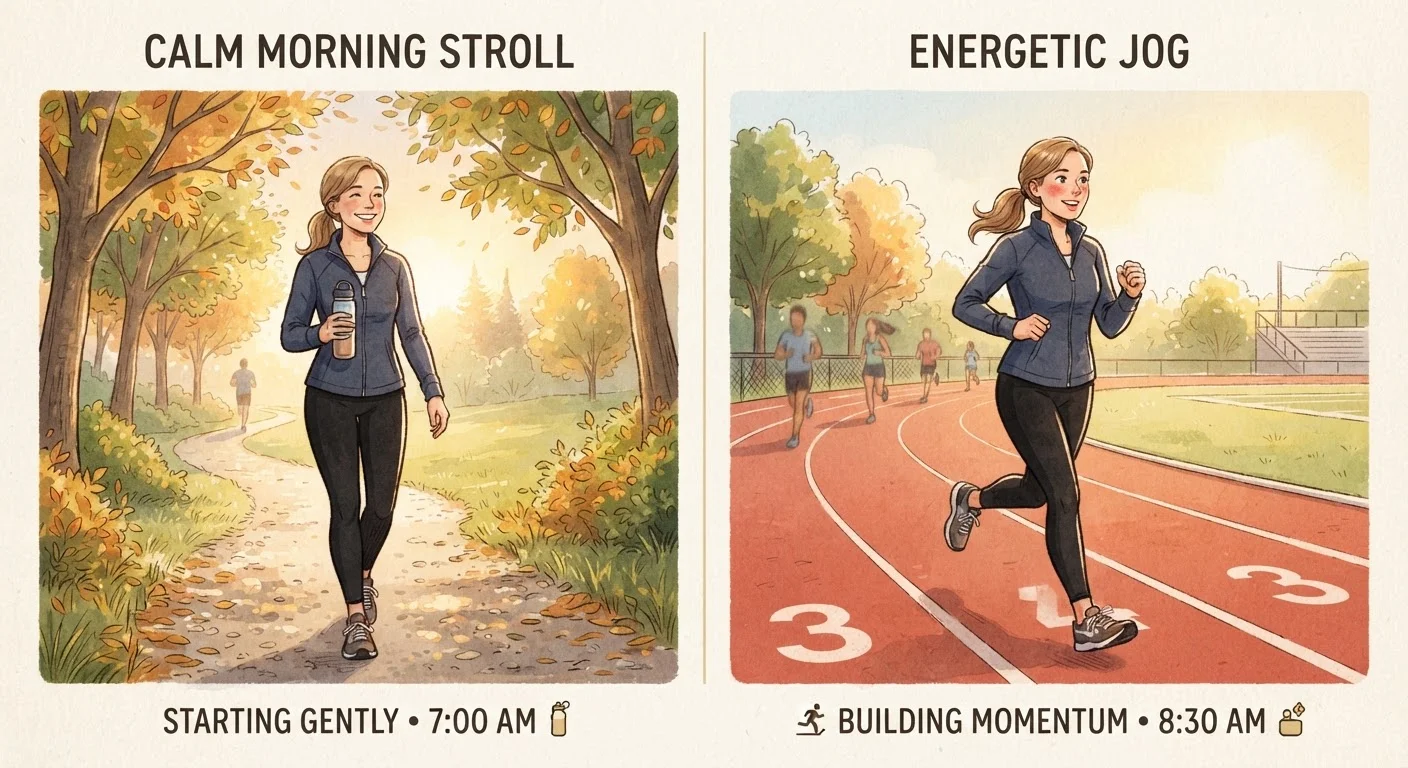
Understanding Exercise Intensity: What Do These Terms Mean?
Before choosing between low- and high-intensity exercise, it helps to understand what intensity actually means. In exercise science, intensity refers to how hard your body is working relative to its maximum capacity. It is most commonly measured using heart rate zones or the Rate of Perceived Exertion (RPE) scale - a simple 1-10 self-rating of effort.
Low-intensity exercise typically falls in the range where you can hold a full conversation comfortably. Think brisk walking, gentle cycling, light swimming, or easy yoga. Your heart rate stays at roughly 50-65% of its estimated maximum.
High-intensity exercise pushes you toward your limits - breathing becomes labored, speaking in full sentences becomes difficult, and your muscles fatigue quickly. Examples include sprint intervals, high-intensity interval training (HIIT), and vigorous cycling or rowing. Heart rate often reaches 75-90% of maximum.
Understanding where you fall on this spectrum is the first step to choosing appropriately. For more on how different cardio formats compare, see our guide to steady-state cardio vs. interval training.
Low-Intensity Exercise: Benefits and Limitations for Beginners
Low-intensity exercise is widely regarded as the most beginner-friendly starting point, and for good reason. Here is what the research and exercise science community generally support:
- Lower injury risk: Gentler movement places less mechanical stress on joints, tendons, and muscles that are not yet conditioned to high loads.
- Sustainable habit formation: Because it feels manageable, beginners are more likely to show up consistently - and consistency drives long-term results.
- Accessible for most populations: Low-intensity movement is generally appropriate across a wide range of ages, body weights, and fitness levels. Those with joint concerns may also find our overview of low-impact exercise options helpful.
- Supports cardiovascular health: Even moderate-effort exercise has well-documented benefits for heart health, blood pressure, and metabolic function.
The main limitation is that progress can feel slow. As your fitness improves, low-intensity sessions alone may not continue to challenge your cardiovascular system - meaning you will eventually need to add variety or increase effort to keep improving.
Use the 'Talk Test' to Gauge Effort
A simple way to check your intensity without any equipment is the talk test. If you can speak in full sentences comfortably, you are likely in the low-intensity zone. If you can manage only a few words between breaths, you are working at a high intensity. This self-check takes the guesswork out of effort levels for beginners who don't yet own a heart rate monitor.
High-Intensity Exercise: Benefits and Risks for Beginners
High-intensity training has earned considerable attention in recent years due to its time efficiency and documented effectiveness. However, for beginners specifically, the picture is more nuanced.
Potential benefits include:
- Greater calorie expenditure in a shorter session
- Faster improvements in aerobic capacity (VO2 max)
- Elevated post-exercise metabolic rate, often called the "afterburn" effect
Key risks for beginners:
- Overuse and acute injuries: Muscles, tendons, and connective tissue need time to adapt. Jumping into high-intensity work too early is a common cause of setbacks - a pattern covered in our article on early exercise mistakes that can slow your progress.
- Poor movement quality under fatigue: When form breaks down, injury risk rises. Beginners often haven't yet built the body awareness to maintain safe technique at high effort.
- Burnout and dropout: Workouts that feel extremely hard from day one can undermine motivation and make it harder to stay consistent.
If you do incorporate high-intensity sessions, recovery becomes especially important. Our guide on recovery for high-intensity training explains what a thoughtful recovery plan looks like.
| Low-Intensity Exercise | High-Intensity Exercise | |
|---|---|---|
| Injury Risk for Beginners | Low - gentle on joints and tissues | Higher - demands movement competency |
| Time per Session | Typically longer (30-60 min) | Shorter sessions possible (15-30 min) |
| Calorie Expenditure | Moderate per session | Higher per session |
| Ease of Recovery | Quick - suitable for daily activity | Needs structured rest days |
| Motivation & Sustainability | High - feels achievable | Can feel overwhelming early on |
| Cardiovascular Progress | Gradual, steady improvement | Faster gains once adapted |
| Best Starting Point | Ideal for absolute beginners | Better after a fitness base is built |
How to Progress Safely as a Beginner
The most evidence-informed approach for beginners is a gradual progression model - start low, build consistency, then thoughtfully increase intensity. Here is a simple framework:
- Weeks 1-3: Establish a movement habit with 3-4 low-intensity sessions per week (20-30 minutes each). Focus on enjoying the process and learning basic movement patterns.
- Weeks 4-6: Extend session duration or add a gentle challenge, such as a short uphill walk or a slightly faster pace.
- Weeks 7+: Introduce one higher-effort segment per week - for example, 20-second bursts of faster effort followed by recovery. Monitor how your body responds before adding more.
Whether you train at home or in a gym will also influence which approach fits your situation. See our comparison of bodyweight training and gym machines for guidance on getting set up.
This article is for general informational and educational purposes only and does not constitute medical advice. Always consult a qualified healthcare professional before starting a new exercise program, especially if you have any existing health conditions or concerns.