
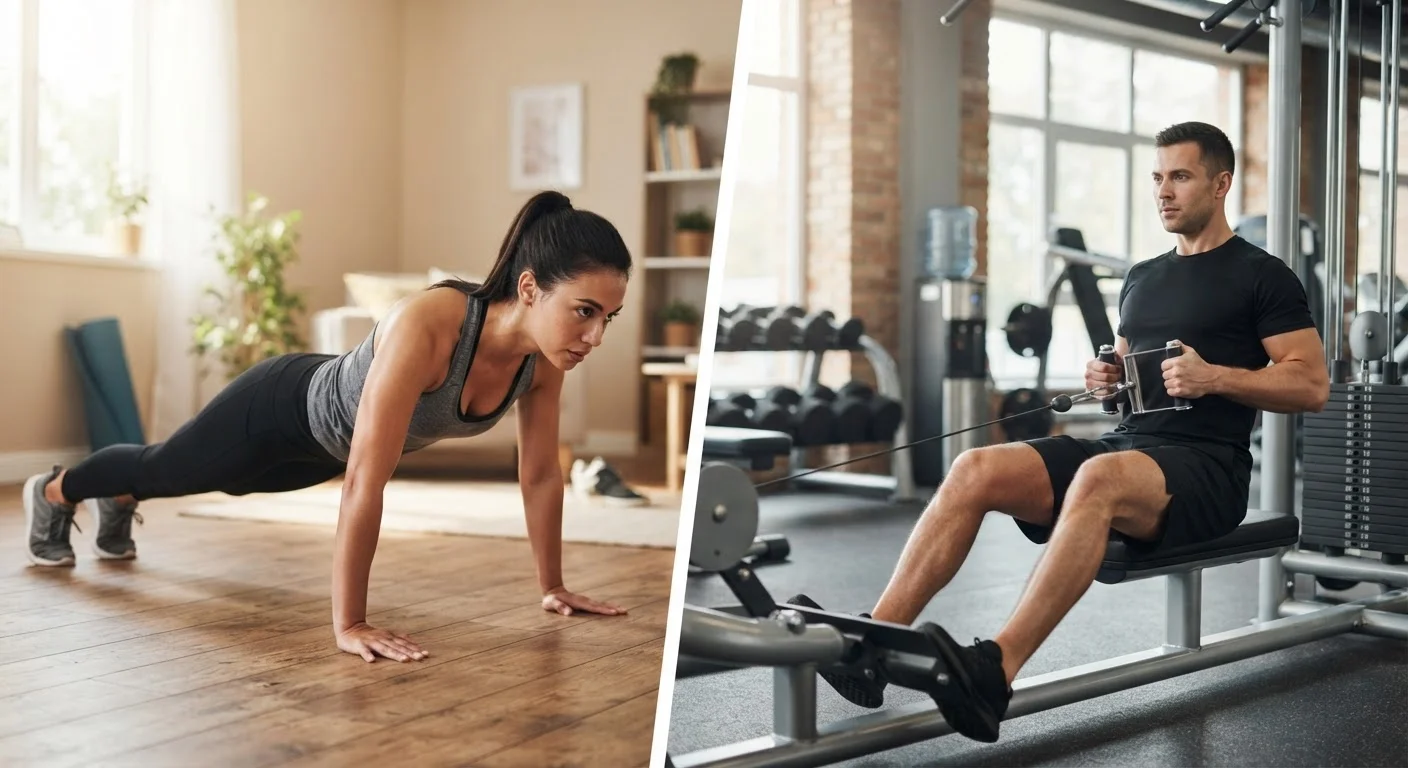
Why This Choice Matters for Beginners
When you're just starting out, one of the most common questions is: should I train at home with my own bodyweight, or should I head to the gym and use the machines? It feels like a big decision - but the truth is, both options can work. What actually matters is understanding what each approach offers, so you can choose the one that fits your situation and stick with it.
For a deeper look at how strength training works before you decide on a method, see our beginner's guide to strength training. And if you're curious how bodyweight exercise compares to all forms of weighted training, our article on bodyweight vs. weighted exercise covers that broader comparison.
| Criterion | Bodyweight Training | Gym Machines |
|---|---|---|
| Cost | Free - no equipment needed | Gym membership required |
| Accessibility | Train anywhere, anytime | Requires gym visit |
| Learning curve | Moderate - form matters | Low - movement is guided |
| Load progression | Exercise variation-based | Precise weight increments |
| Muscle coordination | High - full stabilisation required | Lower - path is fixed |
| Injury risk for beginners | Low if progressed carefully | Low with machine guidance |
| Long-term scalability | High with advanced progressions | High with varied equipment |
What Bodyweight Training Actually Develops
Bodyweight training uses your own mass as resistance. Exercises like push-ups, squats, lunges, and planks require no equipment and can be done in a living room, park, or hotel room. For beginners, this accessibility is a genuine advantage - removing the barrier of cost or travel means you're more likely to actually start.
Beyond convenience, bodyweight exercise develops something machines don't prioritize: movement control. Because you're not guided by a fixed track, your muscles learn to coordinate and stabilize your body through each rep. This builds what exercise scientists call neuromuscular control - the ability of your nervous system and muscles to work together efficiently - which is a valuable foundation for any future training.
Progression is real, though less immediately obvious. Moving from a standard push-up to an incline or archer push-up, or from a regular squat to a single-leg squat, represents meaningful increases in difficulty. Our guide on building a home workout routine without equipment shows how to structure these progressions into an actual weekly plan.
8 weeks
Time to notice beginner strength gains
Research consistently shows that beginners can experience measurable strength improvements within 6-8 weeks of regular resistance training, regardless of the method used.
2-3×
Recommended weekly training frequency for beginners
Exercise guidelines from organisations such as the American College of Sports Medicine recommend beginners train major muscle groups two to three times per week for optimal adaptation.
What Gym Machines Offer That Bodyweight Can't
Gym machines - think leg press, cable rows, chest press - provide a fixed movement path. That guidance is actually a significant beginner benefit: you don't need to worry as much about technique failure causing injury, and you can focus on feeling the target muscle working.
The standout advantage of machines is quantifiable, incremental progression. Weight stacks allow you to add as little as five pounds per session, making progressive overload (gradually increasing the challenge to keep building strength) simple to apply and easy to track. This predictability helps beginners build momentum and see measurable improvement.
Machines also reduce gym anxiety around free weights. For many beginners, picking up a barbell surrounded by experienced lifters feels intimidating. A cable row or leg press station is less socially charged, giving you space to learn at your own pace. If you eventually want to transition toward free weights, our article on free weights vs. machines explains how to think through that shift.
This article provides general fitness information and is not a substitute for professional medical or exercise advice. If you have any health concerns or existing injuries, consult a qualified healthcare professional before starting a new exercise programme.
Making a Practical Decision
Neither option is universally superior. What works is the method you'll actually use consistently. A few practical questions can help you decide:
- Do you have gym access? If cost or location is a barrier, bodyweight training removes that friction entirely.
- Do you have any joint concerns? Machine-guided movement may offer a safer starting point - but always check with a healthcare provider first.
- What motivates you? Some people thrive in the structure of a gym environment; others prefer the privacy of home. Our piece on group classes vs. solo training explores how your environment affects consistency.
Many beginners ultimately find value in both: starting with bodyweight to build confidence and body awareness, then adding machine work as they grow. That's not indecision - that's good programming. You can also explore how intensity fits into your early training with our guide on low-intensity vs. high-intensity exercise for beginners.
You Don't Have to Choose Forever
Many beginners treat this as a permanent either/or decision - it isn't. Bodyweight and machine training can coexist in the same programme. Starting with one doesn't lock you out of the other. As your fitness grows, combining both methods can offer a more complete approach to building strength, stability, and confidence.