
Why Fitness Vocabulary Matters for Beginners
Walking into a gym - or even browsing a workout app - can feel like entering a foreign country. Trainers talk about periodisation, fitness articles mention RPE, and online programs list AMRAP without a second thought. If these terms leave you confused, you're not alone, and the problem isn't you - it's that no one stopped to explain the language.
Learning key fitness terms isn't about sounding knowledgeable at the gym. It's practical. When you understand what a term means, you can follow a workout plan accurately, avoid common mistakes, and make progress more safely. Think of this guide as your translation layer between fitness content and confident action.
For a broader look at how different types of movement fit together, see The Major Exercise Categories Every Beginner Should Know. And if you've already picked up some ideas about working out that don't quite feel right, Fitness Myths That Hold Beginners Back is worth a read alongside this one.
Rep (Repetition)
One complete execution of an exercise movement - for example, lowering and raising your body through a single push-up. Reps are the smallest unit of measurement in a workout plan.
Set
A group of consecutive reps performed without stopping. Workout plans typically prescribe multiple sets of each exercise, separated by a rest period.
Progressive Overload
The gradual increase in training demand placed on the body over time. This can mean more weight, more reps, less rest, or greater range of motion - and it's the core mechanism behind fitness improvement.
HIIT
High-Intensity Interval Training. A training format that alternates short, intense work periods with brief recovery intervals. Effective for cardiovascular fitness and adaptable to many exercise types.
DOMS
Delayed Onset Muscle Soreness. The muscle tenderness that typically appears 24-48 hours after intense or unfamiliar exercise. A normal response to physical stress, not an injury.
RPE
Rate of Perceived Exertion. A subjective 1-10 scale used to describe how hard an effort feels. Helps individuals self-regulate intensity during workouts without equipment.
AMRAP
As Many Reps (or Rounds) As Possible. A workout format in which you perform as many repetitions or full rounds of a circuit as you can within a set time limit.
Compound Exercise
An exercise that engages multiple muscle groups and joints simultaneously - such as a squat or deadlift. Compound movements are efficient and form the backbone of most beginner strength programs.
Isolation Exercise
An exercise that targets a single muscle group, such as a bicep curl. Often used alongside compound movements to address specific muscles.
Periodisation
The structured variation of training volume and intensity over planned time periods (weeks or months). It's used to manage fatigue, prevent plateaus, and peak performance at specific times.
Warm-Up
A period of low-intensity activity performed before the main workout to gradually increase heart rate, blood flow, and joint mobility. It helps prepare the body and reduce injury risk.
Cool-Down
A period of gentle movement and stretching performed after exercise to help the body return to its resting state. Supports recovery and reduces post-exercise stiffness.
The Core Terms You'll See in Almost Every Workout
Most workout plans are built on a handful of recurring concepts. Once you recognize these, the structure of any program becomes much easier to decode.
| What is a rep? | One complete execution of an exercise movement |
| What is a set? | A group of consecutive reps without stopping |
| What does HIIT stand for? | High-Intensity Interval Training |
| When does DOMS peak? | Typically 24-48 hours after intense or new exercise |
| What does RPE measure? | Perceived effort on a scale of 1-10 |
| Core principle of all fitness progress | Progressive overload |
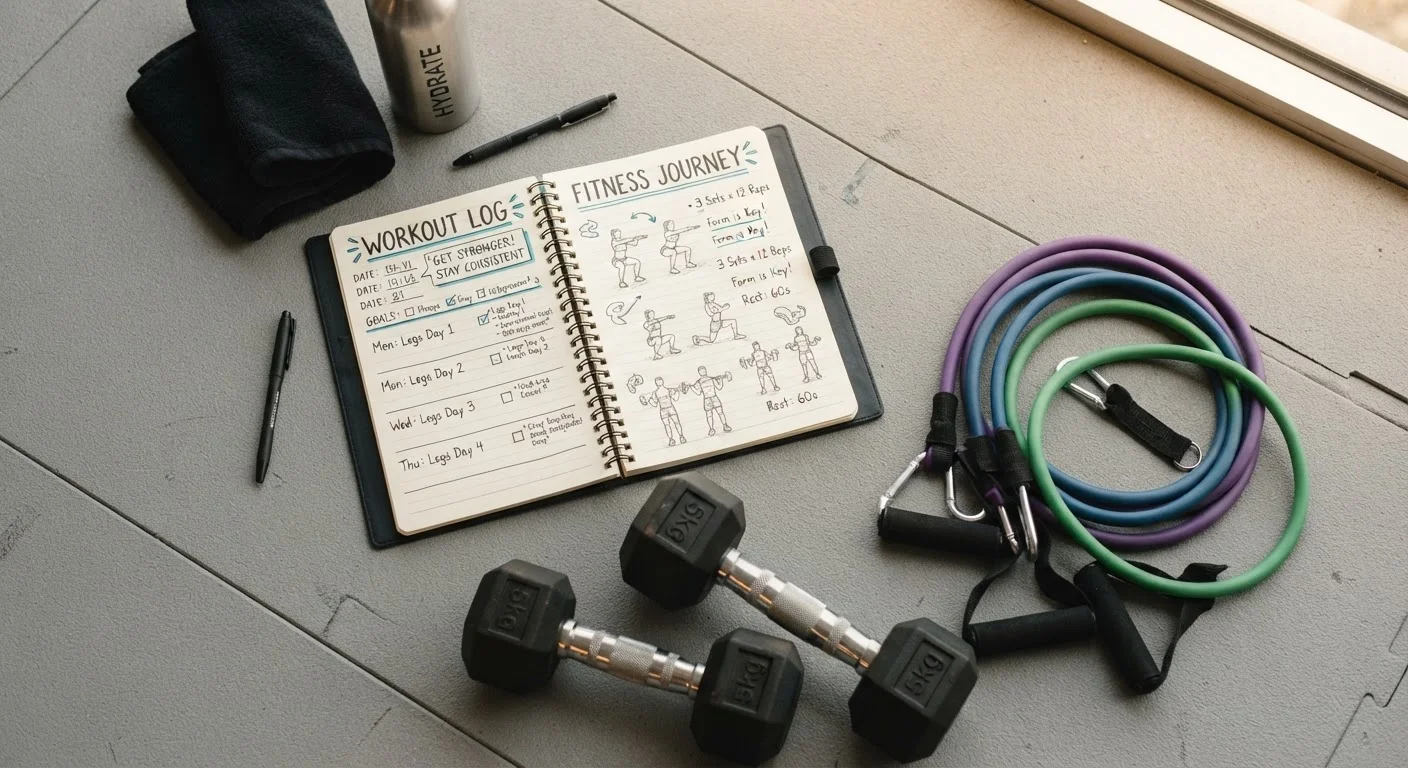
Reps and sets are the foundation. A rep (short for repetition) is one complete movement - one squat, one push-up, one bicep curl. A set is a group of consecutive reps performed without stopping. So "3 sets of 10 reps" means doing 10 repetitions, resting, and repeating that sequence three times total.
Rest intervals refer to the planned pause between sets. Rest is not laziness - it's a deliberate training variable. Shorter rest periods (30-60 seconds) tend to keep your heart rate elevated and are common in circuit training. Longer rest periods (2-3 minutes) support heavier strength efforts.
Progressive overload is arguably the most important concept in all of fitness. It means gradually increasing the challenge placed on your body over time - whether that's more weight, more reps, less rest, or greater range of motion. Without progressive overload, your body adapts and stops changing. For a deeper look at applying this principle, see Strength Training for Beginners.
HIIT stands for High-Intensity Interval Training - alternating short bursts of intense effort with brief recovery periods. It's popular for cardiovascular conditioning and can be adapted to many fitness levels.
DOMS (Delayed Onset Muscle Soreness) is the muscle tenderness that typically peaks 24-48 hours after unfamiliar or intense exercise. It's a normal response to training stress, not an injury signal, and it generally eases with light movement and adequate recovery. Explore strategies to manage it through our Workout Recovery hub.
RPE stands for Rate of Perceived Exertion - a self-reported scale (often 1-10) of how hard an effort feels. It helps you regulate intensity without needing specialized equipment. An RPE of 6 might feel comfortably challenging; a 9 would feel near-maximal.
For an expanded A-to-Z reference covering additional terms like VO2 max and tempo, see the Reference Glossary of Common Exercise Terms for Beginners. Men looking for gym-specific vocabulary may also find the Men's Fitness Glossary a useful companion.
This article is for general informational purposes only and does not constitute medical or professional fitness advice. Consult a qualified healthcare provider or certified fitness professional before beginning a new exercise program, particularly if you have any health conditions or concerns.