
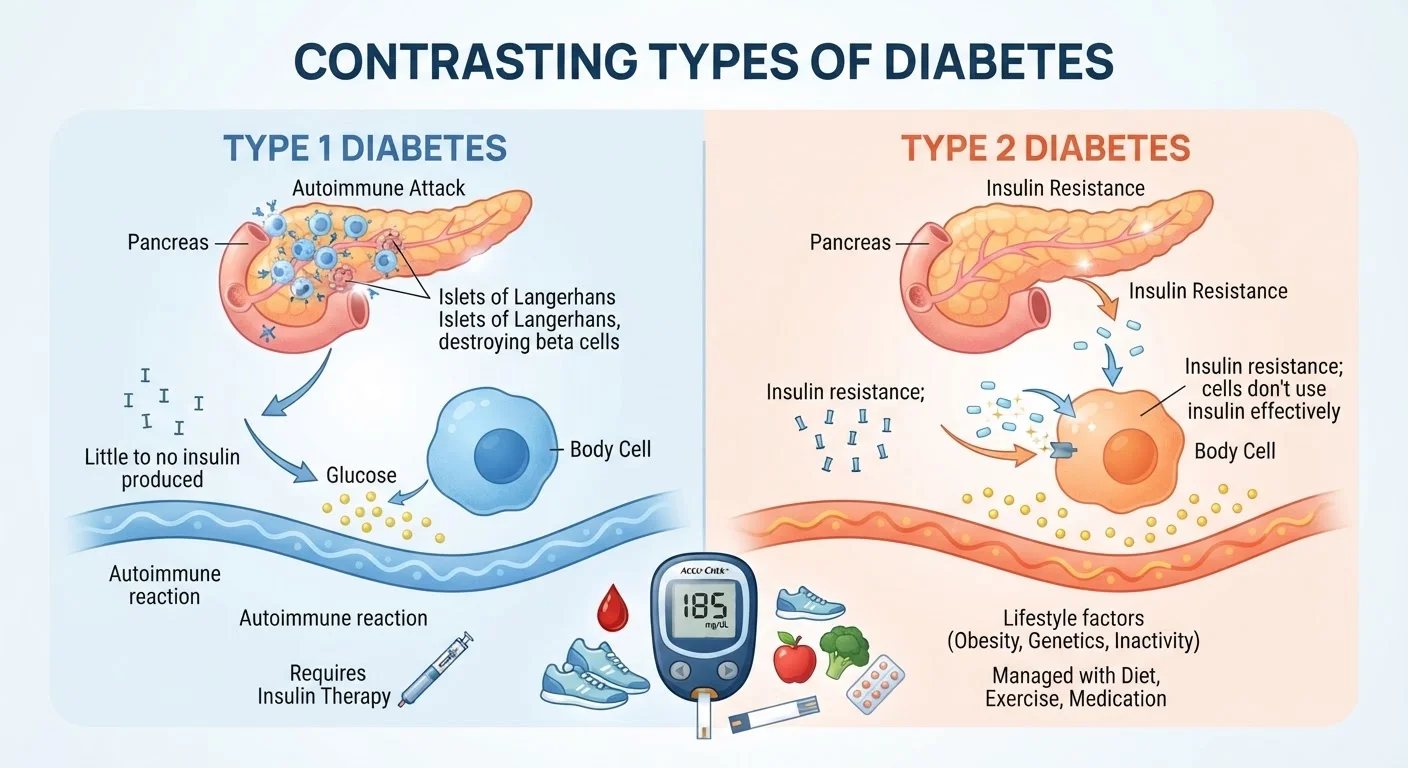
The Core Difference: Cause and Mechanism
Both types of diabetes involve problems with insulin - the hormone produced by the pancreas that allows cells to absorb glucose (sugar) from the bloodstream for energy. However, why that process breaks down is fundamentally different.
In type 1 diabetes, the immune system mistakenly attacks and destroys the beta cells in the pancreas that produce insulin. This is an autoimmune response, meaning the body treats its own tissue as foreign. The result: little to no insulin production at all. Without insulin, glucose builds up in the blood to dangerous levels.
In type 2 diabetes, the pancreas still produces insulin, but either the body's cells become resistant to its effects (insulin resistance), or the pancreas cannot produce enough to keep up with demand - often both. Glucose again accumulates in the bloodstream, but through a different pathway. For a plain-language walkthrough of how type 2 develops, see our introduction for the newly diagnosed.
| Criterion | Type 1 Diabetes | Type 2 Diabetes |
|---|---|---|
| Underlying cause | Autoimmune destruction of beta cells | Insulin resistance and/or insufficient production |
| Insulin production | Little to none | Present but inadequate or ineffective |
| Typical age of onset | Children, teens, young adults | Adults 45+; increasingly younger |
| Preventable? | Not currently preventable | Risk can be reduced with lifestyle changes |
| Symptom onset speed | Rapid (days to weeks) | Gradual (often years) |
| Primary treatment | Insulin therapy always required | Lifestyle, oral medications, possibly insulin |
| Share of diabetes cases (US) | 5-10% | 90-95% |
Who Gets It and When
Type 1 diabetes can develop at any age, but it most commonly appears in children, teenagers, and young adults. It affects roughly 5-10% of all people with diabetes in the United States, according to the Centers for Disease Control and Prevention (CDC). There is no known way to prevent it, and it is not caused by diet or lifestyle.
Type 2 diabetes accounts for approximately 90-95% of all diabetes cases and typically develops in adults over 45, though rising rates of obesity have made it increasingly common in younger adults and adolescents. Risk factors include being overweight, physical inactivity, family history, and certain ethnic backgrounds that carry higher genetic predisposition.
90-95%
Of US diabetes cases that are type 2
According to the Centers for Disease Control and Prevention (CDC), the vast majority of the estimated 38 million Americans with diabetes have type 2.
5-10%
Of US diabetes cases that are type 1
The CDC estimates type 1 affects approximately 2 million Americans, with thousands of new cases diagnosed each year across all age groups.
1 in 5
People with diabetes unaware of their diagnosis
The CDC estimates roughly 8.5 million Americans have undiagnosed diabetes, underscoring the importance of routine blood sugar screening.
A key point worth emphasizing: neither type is caused by eating sugar. This persistent myth can prevent people from seeking care or from understanding their diagnosis accurately.
Symptoms, Diagnosis, and How They Differ in Practice
The hallmark symptoms of both types overlap considerably: frequent urination, excessive thirst, unexplained weight loss, fatigue, and blurred vision. The distinction lies in onset speed.
Type 1 often presents rapidly and severely - sometimes within days or weeks - and can escalate to diabetic ketoacidosis (DKA), a life-threatening condition where the body breaks down fat for fuel and produces acidic ketones. Type 2 symptoms tend to develop gradually, and many people live with the condition for years before diagnosis because symptoms can be subtle.
Diagnosis for both typically involves blood tests measuring fasting glucose, an A1C (a measure of average blood sugar over roughly three months), or an oral glucose tolerance test. Additional antibody tests can help confirm type 1 when there is diagnostic uncertainty in adults.
When Type Is Uncertain: LADA
A condition called Latent Autoimmune Diabetes in Adults (LADA) is sometimes misdiagnosed as type 2 because it develops slowly in adults. Like type 1, it involves autoimmune destruction of beta cells, confirmed through antibody testing. If you are an adult with a type 2 diagnosis that is not responding to typical treatments, ask your provider whether additional testing is warranted.
Just as two conditions can appear similar on the surface but differ biologically - as explored in our article on food intolerance vs. food allergy - diabetes types require distinct clinical approaches despite sharing a name.
Management: Different Roads, Some Shared Goals
The goal for both conditions is the same - keeping blood glucose within a healthy range to prevent complications including nerve damage, kidney disease, and cardiovascular problems. But the tools to get there differ substantially.
Type 1 always requires insulin, delivered by injections or an insulin pump. Because the pancreas produces none, there is no alternative. Continuous glucose monitors (CGMs) are widely used to track levels in real time. Careful carbohydrate counting and dose adjustments are part of daily life.
Type 2 management often begins with lifestyle modifications - nutrition changes, increased physical activity, and weight management - alongside oral medications such as metformin. Some people with type 2 eventually require insulin as the condition progresses, but this is not universal. Treatment is individualized and evolves over time.
Anyone living with either condition should work closely with an endocrinologist or diabetes care team to develop a management plan suited to their specific needs. This article is general health information only and is not a substitute for personalized medical advice.
This article is for informational purposes only and does not constitute medical advice. Always consult a qualified healthcare professional for diagnosis, treatment decisions, or any concerns about your health.