
Why the Pathogen Type Matters
When you get sick, the instinct is often to reach for an antibiotic - or assume rest will fix everything. But the type of organism causing your illness determines what, if any, treatment will actually work. Using the wrong treatment doesn't just fail; it can contribute to drug resistance or delay a proper diagnosis.
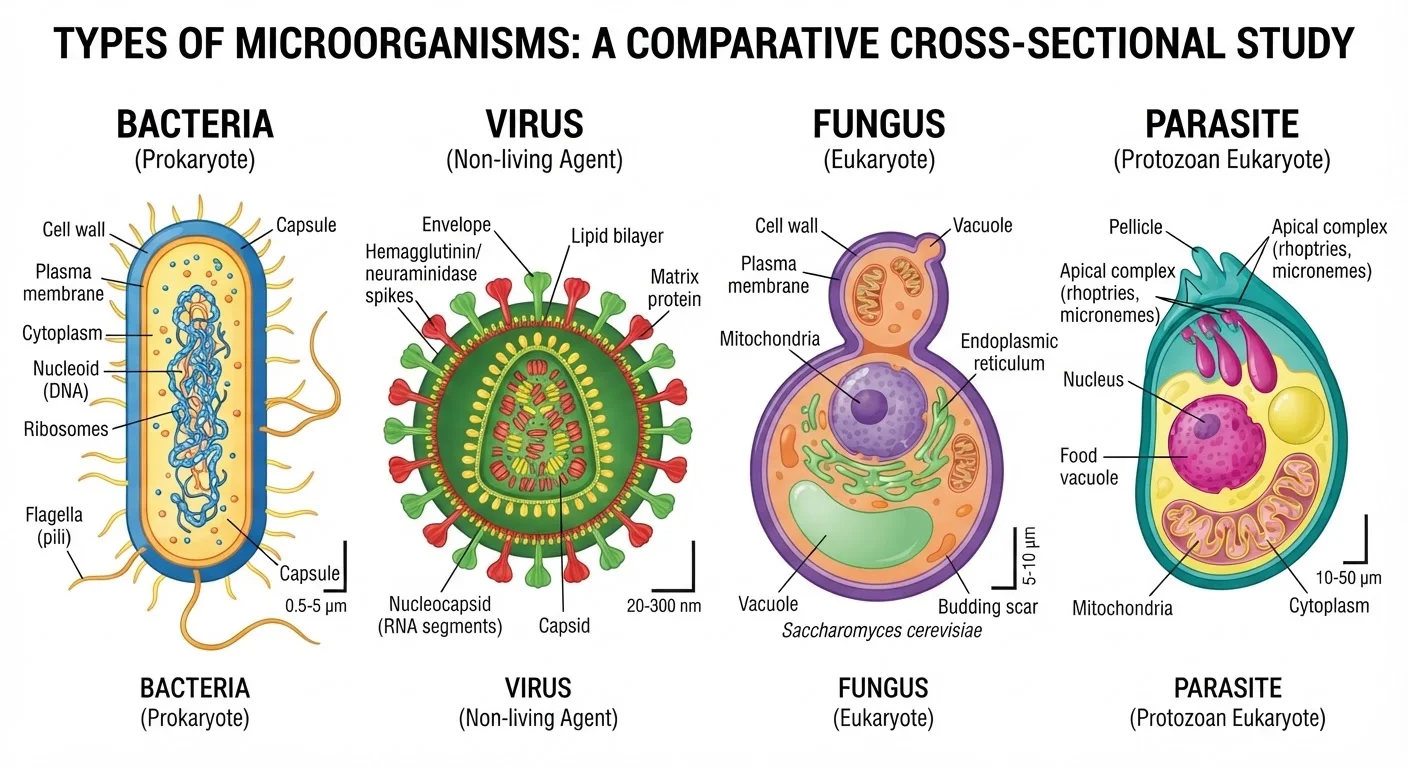
The four main categories of infectious agents - bacteria, viruses, fungi, and parasites - differ fundamentally in their biology, how they cause disease, and how medicine targets them. Understanding these distinctions helps you have more informed conversations with your healthcare provider. It also explains why two patients with similar symptoms may need completely different treatments.
For a deeper look at how your body recognizes and responds to these invaders, see our guide to the immune system and infection.
| Criterion | Bacteria / Viruses | Fungi / Parasites |
|---|---|---|
| Cell type | Bacteria: prokaryotic cells; Viruses: not cells | Fungi: eukaryotic cells; Parasites: varies |
| Replication | Bacteria: self-replicating; Viruses: require host cell | Fungi: spores or budding; Parasites: complex life cycles |
| Treatment class | Antibiotics (bacteria); Antivirals (viruses) | Antifungals (fungi); Antiparasitics (parasites) |
| Common examples | Strep throat, flu, COVID-19, UTIs | Athlete's foot, malaria, tapeworm, yeast infection |
| Transmission routes | Contact, droplets, contaminated surfaces | Contaminated water, food, insect bites, soil |
| Diagnostic approach | Culture, rapid antigen tests, PCR | Microscopy, stool analysis, blood smear, cultures |
Bacteria and Viruses: The Most Commonly Confused Pair
Bacteria are single-celled living organisms capable of reproducing on their own. They have their own metabolism and genetic material. Many bacteria are harmless - or even beneficial, as with gut flora - but pathogenic (disease-causing) strains can infect almost any tissue in the body. Common bacterial infections include strep throat, urinary tract infections (UTIs), and tuberculosis.
Viruses are fundamentally different. They are not cells and cannot replicate without hijacking a host's cellular machinery. A virus injects its genetic material into your cells and uses your body's own systems to make copies of itself. This is why antiviral medications must be highly specific - they need to disrupt viral replication without damaging your own cells. Common viral illnesses include influenza, COVID-19, the common cold, and HIV.
The critical clinical implication: antibiotics treat bacterial infections only. Prescribing them for a viral illness is ineffective and accelerates antibiotic resistance, a significant global health concern.
700,000+
Annual deaths linked to antibiotic-resistant bacteria
The World Health Organization estimates over 700,000 deaths per year are attributable to antimicrobial resistance globally, driven in part by antibiotic misuse.
200+ species
Fungal species known to infect humans
According to the CDC, over 200 fungal species are capable of causing human infection, though a small number account for the majority of clinical cases.
~247 million
People affected by malaria annually
The WHO World Malaria Report estimates approximately 247 million cases of malaria - a parasitic disease - occurred worldwide in 2021.
Fungi and Parasites: Underrecognized but Clinically Significant
Fungi are more complex organisms - they have nuclei and cell walls, but their cell wall composition differs from human cells, which is what antifungal drugs exploit. Most people encounter fungi as superficial infections: athlete's foot (tinea pedis), yeast infections (Candida), or ringworm. However, in people with weakened immune systems, fungi can cause serious, systemic infections affecting the lungs or bloodstream.
Parasites are organisms that live on or inside a human host and derive nutrients at the host's expense. They range widely in size and complexity - from single-celled protozoa like Plasmodium (which causes malaria) to multicellular helminths (worms) like tapeworms or roundworms. Transmission routes vary: contaminated water, undercooked meat, insect bites, or soil contact.
Diagnosing parasitic and fungal infections often requires specific laboratory tests, since symptoms can mimic bacterial or viral illness. Environmental factors - travel history, local water quality, immune status - often guide clinical suspicion. Learn more about how environment shapes infection risk in why infections spread faster in some environments.
Symptoms Alone Can't Identify the Pathogen
Fever, fatigue, and inflammation can occur with bacterial, viral, fungal, and parasitic infections alike. Only laboratory testing - ordered by a clinician based on your full history - can reliably identify the causative organism. Avoid self-diagnosing or self-treating based on symptoms, and seek professional evaluation particularly if symptoms are severe, prolonged, or worsening.
This article is for informational purposes only and does not constitute medical advice. Always consult a qualified healthcare professional for diagnosis and treatment of any illness.