
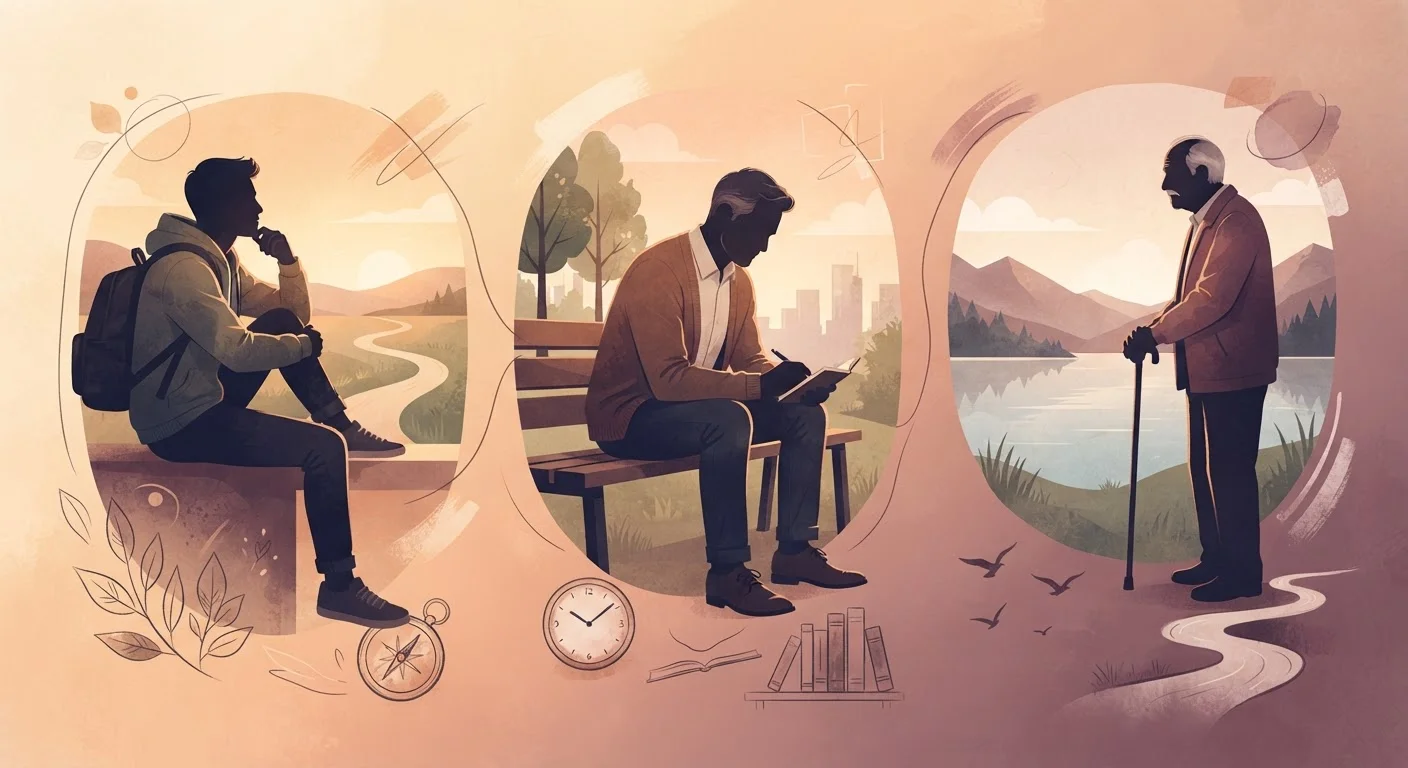
Why Emotional Needs Don't Stay the Same
Mental health is not a fixed state. The pressures, identity questions, and emotional demands a man navigates at 25 look very different from those he faces at 45 or 65. Yet mental health conversations often treat men as a single, undifferentiated group - missing the ways that age reshapes what men need and what puts them at risk.
Understanding how emotional challenges shift across the decades is one of the most practical things a man can do for his long-term well-being. It also helps friends, partners, and family members offer support that's actually relevant. For a grounded starting point, see this accessible introduction to men's mental health.
| Leading mental health concern in men aged 18-34 | Anxiety disorders (SAMHSA National Survey on Drug Use and Health) |
| Suicide rate disparity | Men die by suicide at roughly 3-4x the rate of women (CDC, National Center for Health Statistics) |
| Men who report discussing mental health with a professional | Fewer than 1 in 4 (American Psychological Association, 2023 report) |
| Age range with highest burnout prevalence | 35-49 (Gallup Workplace Report) |
| Social isolation risk elevation | Men over 60 are significantly more likely to be socially isolated (AARP and National Academies of Sciences review) |
Your 20s: Identity, Pressure, and the Performance Trap
Early adulthood is often framed as an exciting frontier, but for many men it's a period of significant psychological strain. Navigating career entry, financial independence, romantic relationships, and social belonging simultaneously creates a compounding pressure that rarely gets named for what it is.
Men in their 20s are more likely to experience anxiety and depression than they realize - partly because those conditions often surface as irritability, risk-taking, or social withdrawal rather than sadness. Cultural expectations around stoicism can make it harder to recognize distress as distress. Anger and frustration are sometimes a mask for deeper emotional pain - a pattern that tends to emerge early.
Key concerns in this decade: establishing a stable identity, managing performance anxiety, and building emotional vocabulary before problems compound.
Your 30s and 40s: Responsibility, Identity Drift, and Burnout
The middle decades often bring a different kind of stress - one built from accumulation rather than uncertainty. Men in their 30s and 40s frequently carry the weight of career advancement, partnership or parenting responsibilities, financial obligations, and aging parents, often with little social permission to show strain.
This is also the period when work identity becomes especially entangled with self-worth. When a job becomes the core of a man's sense of self, setbacks - a missed promotion, a layoff, a business failure - can feel existential rather than circumstantial. Burnout, which is chronic occupational stress that hasn't been managed, is common and frequently unrecognized.
Physical changes also begin affecting mood. Testosterone levels decline gradually after 30, which can influence energy, motivation, and emotional regulation - though these effects vary widely and are often overstated in popular media. A clinician is the right person to evaluate any significant changes.
Burnout
A state of chronic physical and emotional exhaustion caused by prolonged stress, most often associated with workplace demands. It is recognized by the World Health Organization as an occupational phenomenon and is distinct from clinical depression, though the two can co-occur.
Emotional regulation
The ability to manage and respond to emotional experiences in a flexible, constructive way. Poor emotional regulation can manifest as impulsive behavior, anger outbursts, or emotional numbing.
Social isolation
A lack of meaningful contact with others over time. It differs from loneliness, which is a subjective feeling; isolation can exist even when a person is technically around other people.
Testosterone decline
A gradual, natural reduction in the hormone testosterone that typically begins in a man's 30s. While it can affect mood and energy, individual variation is wide and a clinician should evaluate symptoms before attributing them to hormonal change.
Your 50s, 60s, and Beyond: Loss, Purpose, and Connection
Older adulthood brings its own distinct emotional landscape. Men in their 50s and 60s may encounter loss on multiple fronts - the death of parents or peers, children leaving home, retirement removing a key source of identity and structure, and the physical realities of aging. Research consistently shows that older men are at elevated risk for social isolation and that isolation is a significant risk factor for depression.
Suicide rates among older men remain disproportionately high compared to other demographic groups - a sobering reminder that mental health risk does not simply diminish with age or experience. Yet this age group is also among the least likely to seek help, in part due to generational attitudes toward vulnerability.
Rebuilding a sense of purpose, maintaining social connection, and engaging with a healthcare provider about mood changes are protective. If someone in your life is in this stage and struggling, knowing what to say can make a meaningful difference.
3-4×
Higher suicide rate in men vs. women
According to the CDC's National Center for Health Statistics, men consistently die by suicide at a rate three to four times higher than women.
40%
Men who have never discussed mental health with anyone
A survey by the American Psychological Association found a substantial proportion of men have never spoken to anyone - professional or otherwise - about their mental health.
35-49
Peak age range for workplace burnout in men
Gallup's workplace research identifies men in mid-career as among the most susceptible to chronic occupational exhaustion.
This article is for informational purposes only and does not constitute medical advice. If you or someone you know is experiencing a mental health crisis, please contact a qualified healthcare professional or a crisis support line.