
What Are Nutrients and Why Do They Matter?
Nutrients are substances your body cannot make on its own — or cannot make in sufficient quantities — so they must come from the food and beverages you consume. They power every process in your body, from breathing and digestion to immune defense and tissue repair.
Nutrition science organizes these substances into six essential nutrient groups: carbohydrates, proteins, fats, vitamins, minerals, and water. Each group plays a distinct role, and a healthy diet depends on getting an appropriate balance of all six. Understanding what each one does is the first step toward making smarter, more confident food choices.
| Number of Essential Nutrient Groups | 6 (National Institutes of Health (NIH)) |
| Macronutrients (calorie-providing) | Carbohydrates, Proteins, Fats |
| Micronutrients (non-caloric regulators) | Vitamins, Minerals |
| Calories per gram of carbohydrate | 4 kcal (USDA Dietary Guidelines) |
| Calories per gram of protein | 4 kcal (USDA Dietary Guidelines) |
| Calories per gram of fat | 9 kcal (USDA Dietary Guidelines) |
| Water's share of body weight (approx.) | 60% (U.S. Geological Survey (USGS)) |
This article is for general educational purposes only and is not a substitute for personalized medical or dietary advice. Always consult a qualified healthcare professional before making significant changes to your diet.
The Six Nutrient Groups, Explained
The first three groups — carbohydrates, proteins, and fats — are called macronutrients because your body needs them in relatively large amounts and they provide calories (energy). The remaining three — vitamins, minerals, and water — are equally essential but needed in smaller quantities or, in the case of water, serve non-caloric functions.
Macronutrients
Carbohydrates, proteins, and fats — the three nutrient groups needed in large amounts that provide the body with calories (energy).
Micronutrients
Vitamins and minerals required in smaller quantities that support essential body functions without directly supplying energy.
Amino Acids
The building blocks that make up proteins. Some amino acids are 'essential,' meaning the body cannot produce them and must obtain them from food.
Fat-Soluble Vitamins
Vitamins A, D, E, and K, which are absorbed alongside dietary fat and can be stored in body tissues for later use.
Water-Soluble Vitamins
The B vitamins and vitamin C, which dissolve in water, are not stored in significant amounts, and need to be replenished regularly through diet.
Dietary Fiber
A type of carbohydrate that the digestive system cannot fully break down. It supports gut health, helps regulate blood sugar, and contributes to feelings of fullness.
1. Carbohydrates
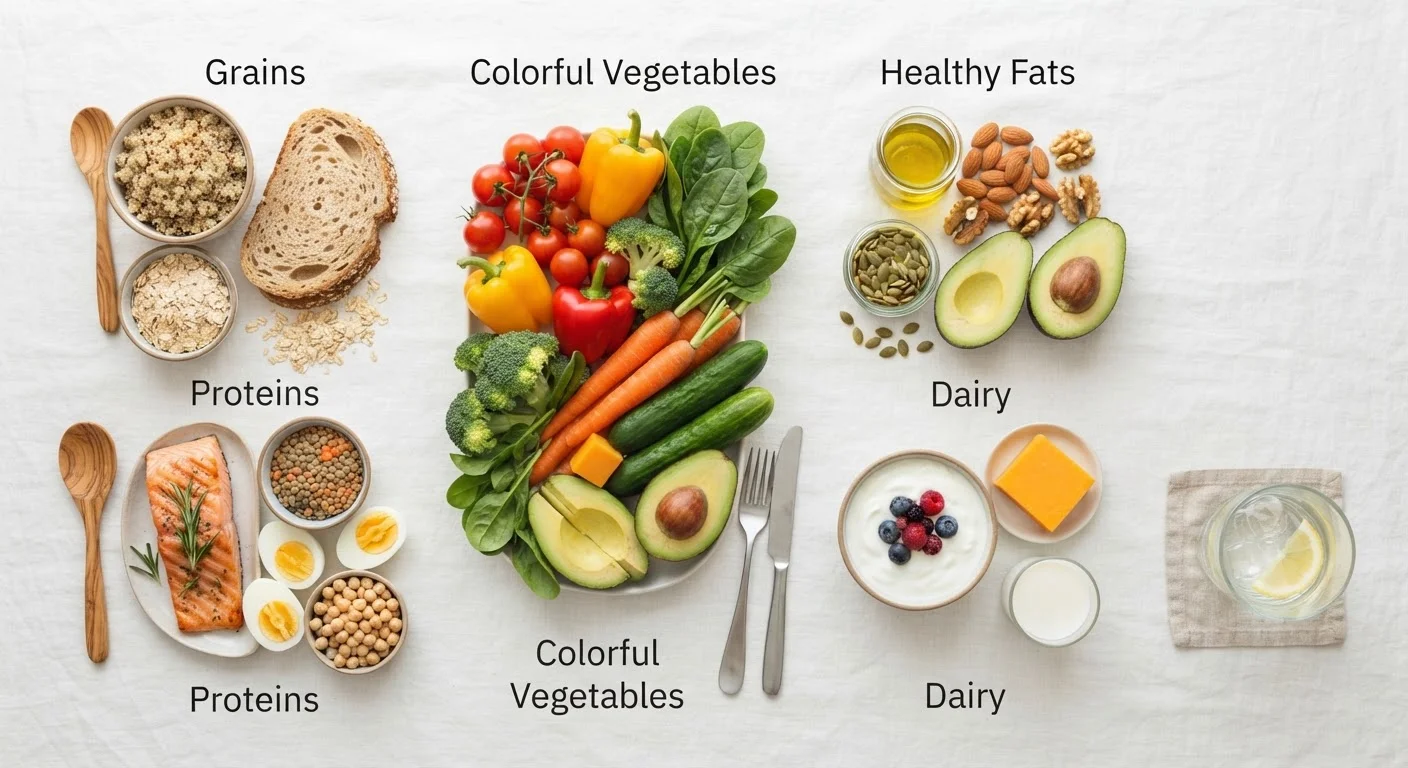
Carbohydrates are your body's preferred and most efficient energy source. When digested, they break down into glucose, which fuels the brain, muscles, and organs. Whole food sources such as vegetables, legumes, whole grains, and fruits also deliver fiber — a type of carbohydrate the body cannot fully digest but that supports healthy digestion and helps regulate blood sugar. See how carbs, fats, and protein each serve distinct functions for a deeper look.
2. Proteins
Proteins are built from chains of amino acids and serve as the body's primary building material. They are essential for constructing and repairing muscle tissue, producing enzymes and hormones, and supporting immune function. Because the body cannot store protein the way it stores fat, regular intake from foods such as eggs, legumes, fish, and poultry is important. Men can explore how macronutrients work in the male body for context specific to their needs.
3. Fats
Dietary fats are the most energy-dense macronutrient. They support cell membrane structure, enable the absorption of fat-soluble vitamins (A, D, E, and K), cushion vital organs, and help regulate hormones. Unsaturated fats — found in foods like avocados, nuts, and olive oil — are generally associated with heart health in research literature. Not all fats are equal, and the type matters as much as the amount.
4. Vitamins
Vitamins are organic compounds that regulate biological processes without providing energy directly. They are divided into two categories: water-soluble (the B vitamins and vitamin C) and fat-soluble (vitamins A, D, E, and K). Each vitamin has specific functions — for example, vitamin D supports bone health and immune signaling, while B vitamins help convert food into usable energy. Learn more in our introduction to vitamins and minerals.
5. Minerals
Minerals are inorganic elements — meaning they come from soil and water rather than living organisms — and your body uses them for a wide range of structural and functional roles. Calcium and phosphorus strengthen bones and teeth; iron carries oxygen in the blood; potassium regulates fluid balance and nerve signals. The Vitamins & Minerals hub covers these in greater detail.
6. Water
Water is often overlooked as a nutrient, but it is the medium in which nearly every chemical reaction in your body occurs. It transports nutrients and waste, regulates body temperature through sweat, lubricates joints, and supports kidney function. According to the National Academies of Sciences, daily adequate intake varies by individual, but most adults need several cups of fluid per day from all sources, including food.
60%
Approximate water content of the adult human body
According to the U.S. Geological Survey, water makes up roughly 60% of body weight — underscoring why adequate hydration is as critical as any other nutrient.
13
Number of essential vitamins recognized by science
The NIH identifies 13 essential vitamins — 4 fat-soluble and 9 water-soluble — each with unique functions that diet alone must supply.
9 kcal/g
Energy density of dietary fat
Fat provides more than twice the calories per gram compared to carbohydrates or protein, making it the body's most concentrated energy reserve.