
What Do These Terms Actually Mean?
The phrase "eat whole foods, avoid processed foods" is common wellness advice — but it glosses over a more nuanced reality. Understanding what each term actually describes is the first step toward making choices that work for your life.
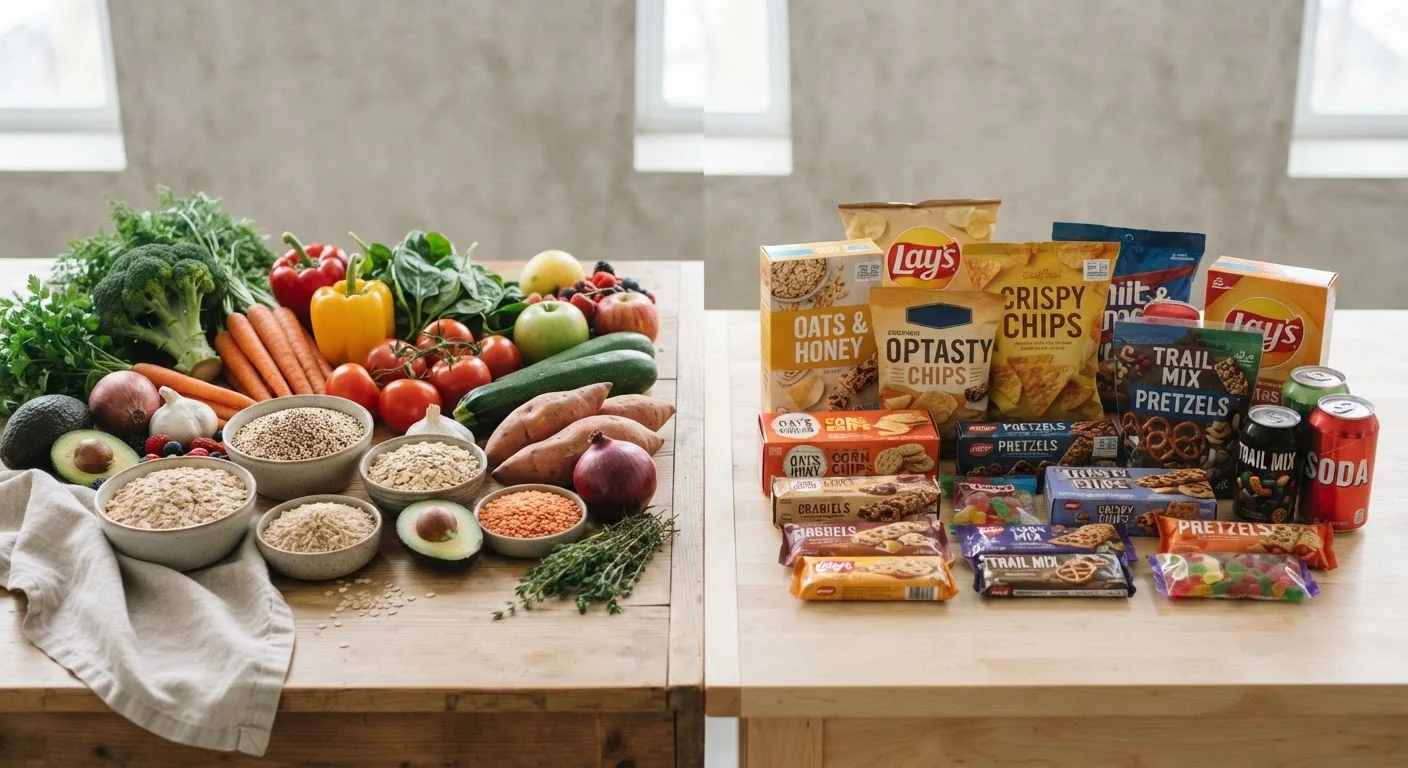
Whole foods are foods that remain close to how they exist in nature. Think an apple, a handful of oats, a piece of salmon, or a cup of lentils. They haven't had major components removed or had significant additives introduced. That said, "whole food" isn't a regulated label — it's a descriptive concept.
Processed foods are any foods that have been altered from their original state through industrial or culinary means. This includes a vast range: washing and bagging spinach, pasteurizing milk, canning tomatoes, milling wheat into flour, and adding preservatives to extend shelf life are all forms of processing. The word "processed" tells you very little on its own.
A more useful framework, developed by Brazilian nutrition researchers and now widely referenced in nutrition science, is the NOVA classification. It groups foods into four categories based on the degree and purpose of processing — from unprocessed or minimally processed foods, through culinary and processed ingredients, to ultra-processed formulations. See what healthy eating actually means for broader context on these foundational concepts.
How They Compare Nutritionally
The nutritional gap between whole and processed foods isn't fixed — it depends heavily on which processed food you're comparing and how it was made.
| Criterion | Whole Foods | Processed Foods |
|---|---|---|
| Definition | Unaltered or minimally altered from natural state | Any food changed from its original form |
| Fiber content | Generally high; intact | Often reduced; varies widely by product |
| Added sugars & sodium | Naturally absent or minimal | Frequently added, especially in ultra-processed items |
| Nutrient density | Tends to be higher per calorie | Ranges from moderate (canned veg) to low (snack foods) |
| Convenience | Requires more preparation time | Ready-to-eat or quick to prepare |
| Cost | Varies; fresh produce can be pricier | Often lower cost per serving |
| Shelf life | Shorter; perishable | Longer; extended by preservation methods |
Where whole foods generally hold an advantage is in fiber content, micronutrient retention, and the absence of added sodium and sugars. An orange, for example, delivers vitamin C, folate, potassium, and fiber together — nutrients that interact within the food matrix in ways that isolated supplements don't fully replicate. This is one reason whole foods are often preferred over supplements as a primary nutrient source.
Ultra-processed foods — those manufactured with industrial ingredients rarely found in home kitchens, such as hydrogenated oils, high-fructose corn syrup, flavor enhancers, and emulsifiers — are the category most consistently associated with lower diet quality in epidemiological research. However, correlation in dietary studies does not straightforwardly confirm causation, and researchers continue to investigate what drives these associations.
57%
Share of US calories from ultra-processed foods
A study published in the British Medical Journal (2016) estimated that ultra-processed foods accounted for roughly 57% of energy intake in the US diet.
4x
More fiber in whole grains vs. refined grains
According to USDA nutrient data, whole wheat flour contains approximately four times the dietary fiber of standard white flour per 100g serving.
Navigating the Grey Area Practically
Most people eat a mix of whole and processed foods every day, and that reflects real life. The goal isn't perfection — it's building a pattern that is nutritious, enjoyable, and sustainable.
Some practical ways to think about it:
- Check the ingredient list, not just the front of the package. A product with five recognizable ingredients is meaningfully different from one with thirty, many of which you'd need a chemistry background to identify.
- Minimally processed staples earn their place. Plain Greek yogurt, canned chickpeas, frozen edamame, and whole-grain pasta are all processed — and all nutritionally worthwhile.
- Context matters. A diet built primarily around vegetables, legumes, whole grains, lean proteins, and fruits — with occasional ultra-processed foods — aligns with patterns supported by major dietary guidelines, including those from the USDA and the World Health Organization.
For a deeper look at how these trade-offs play out meal by meal, explore the practical trade-offs between whole and processed foods.
Special Populations: Extra Care Needed
Pregnant individuals, young children, older adults, and people managing chronic conditions may have specific dietary needs that go beyond general guidance. If you fall into one of these groups, consult a registered dietitian or your healthcare provider before making significant changes to your eating pattern. General nutrition principles are a starting point, not a substitute for individualized professional advice.
This article is for general informational purposes only and does not constitute medical or dietary advice. Please consult a registered dietitian or qualified healthcare professional for guidance tailored to your individual health needs.