
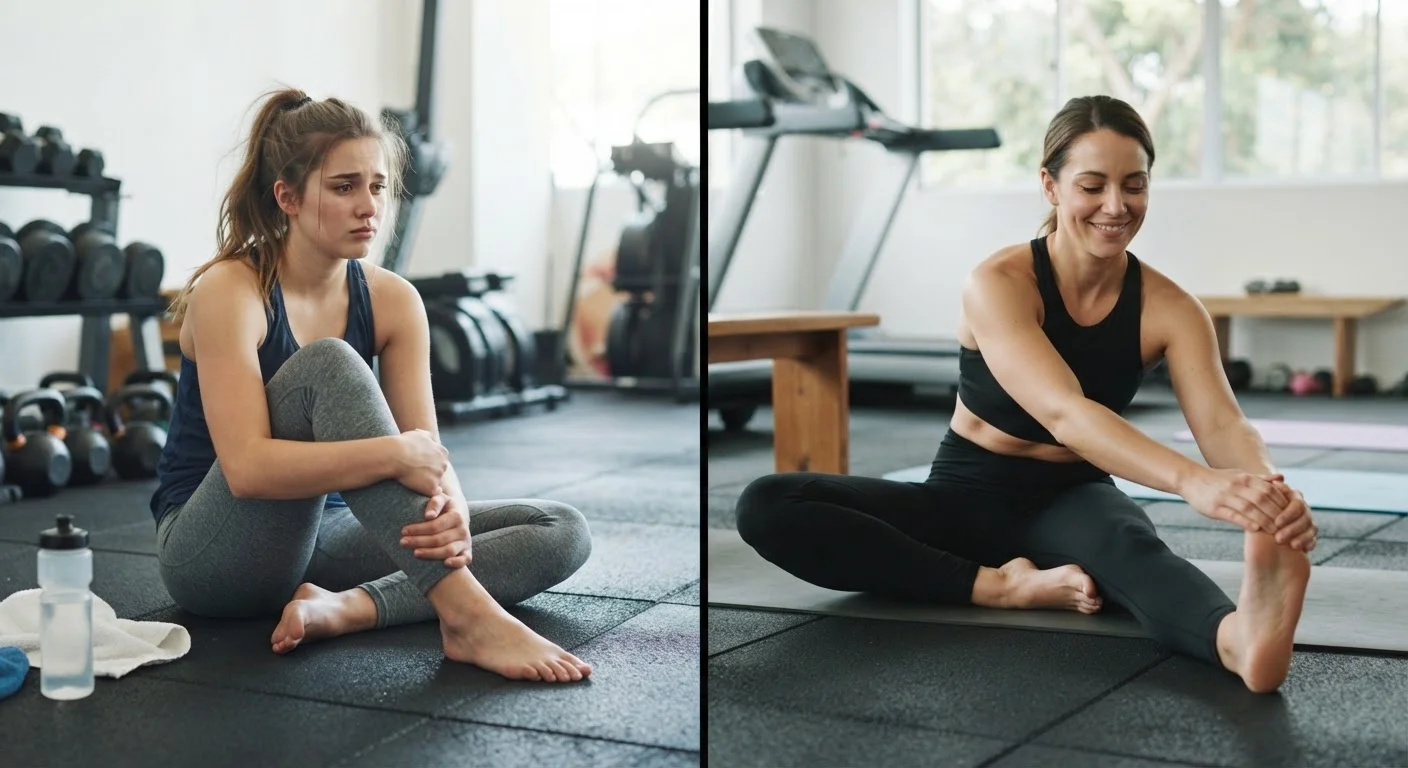
What Normal Post-Workout Soreness Feels Like
After a new or challenging workout, it's common to feel a dull, heavy ache in the muscles you worked - this is known as Delayed Onset Muscle Soreness (DOMS). You can read more about why it happens in our plain-language guide to DOMS.
Normal soreness has a recognisable pattern:
- Timing: It typically develops 12-48 hours after exercise, not during it.
- Location: It's spread across the belly of the muscle - not focused on a joint or a single point.
- Quality: The sensation is dull, aching, or tender to the touch, not sharp or stabbing.
- Symmetry: Both legs feel sore after a squat session, for example, rather than one side only.
- Function: You can still move normally, even if the muscles feel stiff or fatigued.
This discomfort is a byproduct of the repair process your body uses to build stronger muscle tissue. To understand the biology behind it, see our article on what actually happens to your muscles after a workout.
Use the "24-Hour Rule" as a Starting Guide
If you finish a workout feeling fine but wake up sore the next morning, that delayed onset is usually a good sign - it means your muscles were challenged. If you felt pain during the workout itself, treat that as a separate concern worth investigating before your next session.
Warning Signs That Point to an Injury
Not all workout pain is productive. Certain characteristics suggest something has gone wrong beyond normal adaptation - and those signals deserve your attention.
Red flags to watch for:
- Sharp or stabbing pain during the exercise itself, not hours later.
- Pain localised to a joint - such as the knee, shoulder, ankle, or wrist - rather than in the muscle belly.
- One-sided pain that doesn't match the effort on the opposite side.
- Swelling, bruising, or visible deformity in the area.
- Pain at rest - meaning it hurts even when you're sitting still or sleeping.
- A popping, snapping, or tearing sensation at the moment of onset.
- Loss of range of motion or joint instability, such as a knee that feels like it might give way.
If you notice any of these signs, stop the activity immediately. Pushing through injury-level pain can turn a manageable problem into a longer-term setback.
Joint Pain and Soreness Are Different
It's important to distinguish between muscle soreness and joint pain. Muscles can productively ache after effort; joints should not be the primary location of post-workout pain. Pain in or directly around a joint - the knee cap, shoulder socket, ankle - should always be taken seriously and assessed by a professional if it persists.
A Simple Decision Framework for Beginners
When you're unsure whether to rest, continue, or seek help, ask yourself these questions:
- Did the pain start during the workout or after? During-workout pain warrants immediate attention; post-workout aching is more likely normal soreness.
- Is the pain sharp and localised, or dull and widespread? Dull and spread across the muscle is typical of DOMS; sharp and focused on one spot is not.
- Does moving the area feel unstable or mechanically wrong? If a joint feels loose or catches, that's a potential injury signal.
- Is it getting better or worse over days? Normal soreness fades within 3-5 days. Pain that lingers or worsens needs professional evaluation.
Understanding when to rest is also about knowing how to recover well. Our post-workout recovery checklist for beginners covers the key steps to support your body between sessions. And if you're unsure how much rest your body actually needs, signs your body needs more recovery time is a helpful next read.
24-72 hrs
Peak window for DOMS onset after exercise
Exercise science literature consistently places peak DOMS discomfort between 24 and 72 hours post-workout, with full resolution typically by day 5.
~30%
Of recreational exercisers report workout-related injuries annually
Research across recreational fitness populations suggests roughly 1 in 3 exercisers experiences some form of injury each year, often linked to overuse or improper load progression.
What to Do Based on Your Assessment
Once you've read the signals, here's a practical starting point for each scenario:
If it's normal soreness:
Rest the affected muscles or switch to a different movement pattern. Light activity - a walk, gentle yoga, or swimming - may help without stressing the recovering tissue. Learn more about your options in our guide to active recovery vs. complete rest.
If the signs point to injury:
Stop training the affected area. Apply the RICE principle as a general first-response approach (Rest, Ice, Compression, Elevation) for acute soft-tissue injuries, and consult a healthcare professional - especially if symptoms don't improve within a few days or are severe at onset.
If you're unsure:
Err on the side of caution. Taking one or two extra rest days costs far less than aggravating a genuine injury. When in doubt, a physiotherapist or sports medicine physician can assess the issue properly.
This article is for informational purposes only and is not a substitute for professional medical advice. If you experience pain that concerns you, please consult a qualified healthcare provider.