
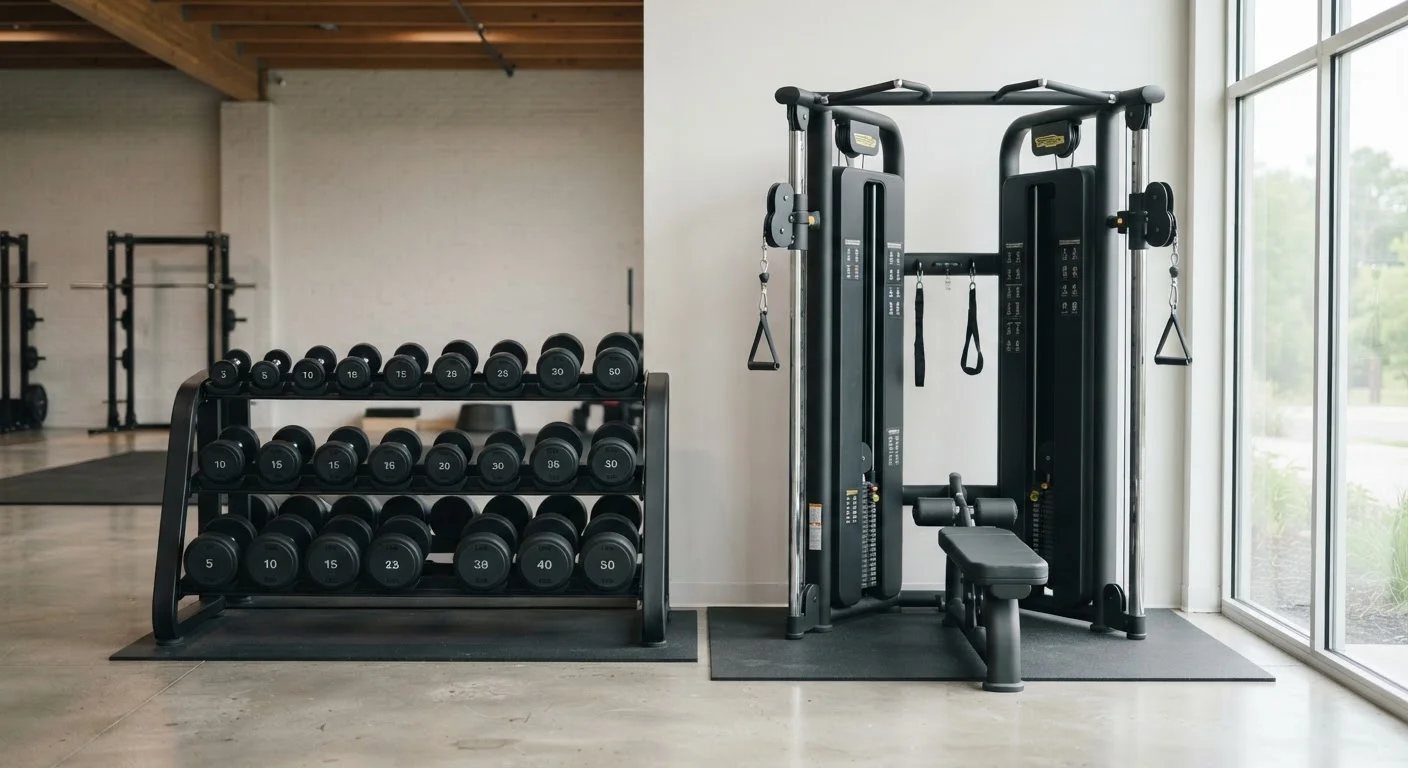
What Each Approach Actually Does to Your Body
When you pick up a dumbbell, your body has to control the weight in three-dimensional space. Every stabilising muscle around the joint fires to keep the movement safe and on course. That demand on your neuromuscular system - the communication network between your brain and muscles - is one reason free weights are strongly associated with functional strength gains.
Machines work differently. The weight travels along a predetermined path set by the equipment's engineering. That guided motion reduces the stabilisation demand, which makes it easier to isolate a specific muscle and maintain consistent form. For someone who is still learning how their body moves under load, that structure is genuinely valuable.
Neither approach simply replaces the other. Think of them as tools with different primary functions. See how they compare directly across key criteria below.
| Criterion | Free Weights | Machines |
|---|---|---|
| Stabiliser muscle recruitment | High - full 3D control required | Low - path is fixed by equipment |
| Learning curve | Steeper - technique is critical | Gentler - guided movement aids beginners |
| Injury risk with poor form | Higher if technique breaks down | Lower due to controlled range of motion |
| Muscle isolation | Harder to isolate single muscles | Effective for targeted isolation |
| Versatility | Very high - endless variation possible | Limited to designed movement pattern |
| Functional carry-over | Strong - mirrors real-world movement | Moderate - less transferable |
| Suitability for rehabilitation | Variable - depends on injury site | Often preferred under clinical guidance |
The Case for Free Weights
Free weights - barbells, dumbbells, kettlebells - shine in compound movements: squats, deadlifts, rows, presses. These exercises train multiple muscle groups simultaneously, which is time-efficient and closely mimics the way your body actually moves in daily life and sport.
Because free weights require you to control the load, they develop proprioception (your body's awareness of its position in space) alongside raw strength. Research in strength and conditioning consistently shows that compound free-weight movements produce high levels of total-body muscle activation. This is part of why programmes structured around barbell lifts remain a foundation of evidence-based strength training.
Free weights also offer near-unlimited scalability. You can adjust load in small increments, alter grip width, change stance, or shift your centre of gravity - giving you enormous variety within a single piece of equipment. To understand how free-weight training fits into broader programme design, see full-body vs. split programme structures.
~43%
Greater stabiliser activation with free weights
A study published in the Journal of Strength and Conditioning Research found free-weight exercises produced meaningfully higher stabilising muscle activity compared to matched machine exercises.
2-3x
Muscle groups engaged per compound lift
Multi-joint free-weight movements like the squat and deadlift engage multiple major muscle groups simultaneously, compared to most machine exercises targeting one primary group.
The Case for Machines
Machines lower the barrier to strength training in meaningful ways. When you sit at a chest press machine, your torso is supported, the range of motion is pre-set, and the risk of a form breakdown that could lead to injury is significantly reduced. For a beginner - or someone returning from an injury - that safety margin matters.
Machines are also effective for isolation work: targeting the biceps, triceps, or hamstrings independently without asking surrounding muscles to assist. This has real value in rehabilitation, muscle imbalance correction, and in the later stages of a workout when fatigue might compromise free-weight form.
If you are deciding between machine-based gym training and other approaches to getting started, bodyweight vs. gym machines for beginners explores how those options compare at an entry level.
A Note on Injury History and Special Populations
If you are managing a musculoskeletal injury, recovering from surgery, or have a chronic health condition, neither free weights nor machines should be introduced without guidance from a physiotherapist or qualified healthcare professional. What is appropriate for a healthy beginner may not be safe for someone in rehabilitation. Always get a personalised assessment before changing your training approach.
How to Build a Programme That Uses Both
The most practical approach for most men is to treat free weights and machines as complementary rather than competing. A well-designed session might anchor its major strength work - squats, deadlifts, overhead press - with free weights, then use machines to finish specific muscle groups with controlled, lower-risk volume.
Experience level should drive the balance. Beginners may spend their first few months primarily on machines while they develop movement literacy, then progressively introduce free-weight compound lifts. Intermediate and advanced lifters typically lean more heavily on free weights, using machines strategically for accessory work.
If the gym environment itself is a factor in your decision-making, it is worth reading about group classes vs. solo training to understand how different settings affect consistency and motivation.
This article is for general informational purposes only and does not constitute medical or personal training advice. Speak with a qualified fitness professional or healthcare provider before starting or significantly changing a strength training programme, particularly if you have an existing injury or health condition.