
Why Nutrition Labels Exist - and What They Actually Tell You
Nutrition Facts panels on packaged foods in the U.S. are regulated by the Food and Drug Administration (FDA). They exist to give consumers a standardized, consistent way to compare foods and make informed dietary decisions. The label was last significantly redesigned in 2016-2020, with updates that included larger calorie font, a separate line for added sugars, and revised %DV references.
What the label doesn't tell you is whether a food is inherently good or bad for you. Context matters: a food high in sodium may be entirely appropriate within a balanced diet for one person and worth limiting for another. The label gives you data - this guide helps you use that data without over-interpreting it.
For a complementary perspective on how food labels look through the lens of micronutrients, see reading a nutrition label through the lens of essential nutrients. If you're reading supplement packaging rather than food labels, the approach differs - supplement label literacy walks through that separately.
What you will need
Step-by-Step: Reading Every Section of the Panel
The Nutrition Facts panel follows a fixed layout. Reading it top to bottom - rather than jumping to whichever number catches your eye - gives you the most accurate picture. Below are the key sections in the order they appear.
Serving Size Is Rarely What You Actually Eat
Food manufacturers set their own serving sizes, which are often smaller than a typical portion. A bag labeled as "2.5 servings" means every number on the label must be multiplied accordingly. Always check serving size before drawing conclusions from any other figure on the panel.
Identify the Serving Size and Servings Per Container
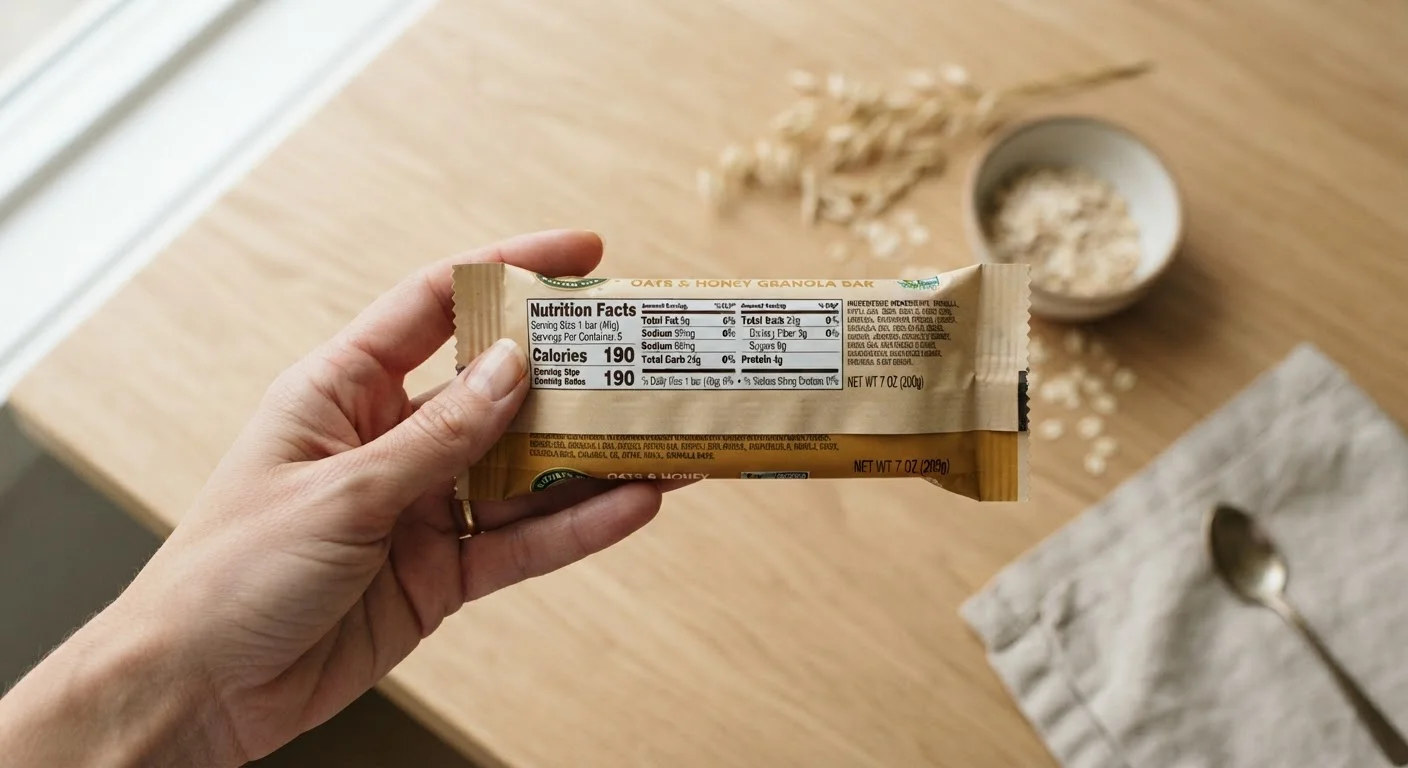
At the very top of every Nutrition Facts panel, you'll find two lines: Serving Size and Servings Per Container. Every other number on the label - calories, fat, sodium, protein - refers to one serving, not the entire package.
If a container holds 3 servings and you eat the whole thing, triple every figure you see. This is where most label misreading begins.
Read the Calorie Count in Context
Calories tell you how much energy one serving provides. For reference, most adult men require roughly 2,000-2,500 calories per day - though individual needs vary significantly based on body size, age, and activity level. A single food's calorie count only means something when weighed against your full day's intake.
Don't use calories as your only filter. A food can be low-calorie and nutritionally sparse, or calorie-dense and genuinely nourishing.
Assess the Fat Breakdown
The label separates total fat into subcategories. Focus on saturated fat and, where listed, trans fat. Dietary guidelines consistently advise limiting saturated fat - found heavily in fatty meats, full-fat dairy, and processed foods - due to its association with cardiovascular risk factors.
Unsaturated fats (monounsaturated and polyunsaturated) are not highlighted as concerns. If a product lists these, they represent the more favorable portion of total fat. For a deeper look at how different fats function in the body, see the practical macronutrient breakdown for men.
Review Sodium and Added Sugars
Sodium and added sugars are the two figures most Americans - and particularly men - tend to overconsume. The FDA recommends staying under 2,300 mg of sodium daily. A single serving of some processed foods can account for 40-50% of that limit.
Added sugars (distinct from naturally occurring sugars in fruit or dairy) are listed separately since 2020 FDA label updates. High added sugar intake is linked to increased risk of metabolic issues over time. If you're monitoring blood pressure, sodium deserves particular attention - see how sodium relates to blood pressure and cardiovascular risk.
Check Protein and Fiber
Protein supports muscle repair, hormone production, and satiety - all particularly relevant for men who exercise regularly or are managing weight. The label shows grams per serving; active men generally need more total daily protein than sedentary individuals, though specific targets should be discussed with a dietitian.
Fiber appears under total carbohydrates. Most men fall well short of the 38g daily adequate intake. Fiber slows digestion, supports gut health, and helps moderate blood sugar response. Foods with 3g or more of fiber per serving are considered a good source. For context on how carbohydrates - including fiber - work within the body, the essential nutrients hub provides useful background.
Use % Daily Value to Calibrate Quickly
The right-hand column of the panel shows % Daily Value (%DV) - the percentage of the recommended daily amount that one serving provides, based on a 2,000-calorie reference diet. This is your fastest decision-making tool.
Use %DV to limit saturated fat, sodium, and added sugars (keep these low), and to seek out fiber, potassium, vitamin D, calcium, and iron (aim higher). Vitamins and minerals listed on the label are now standardized to the most current reference values.
Scan the Ingredients List
The ingredients list runs in descending order by weight. Whatever appears first makes up the largest proportion of the product. If refined flour, sugar, or a form of oil appears in the top three ingredients of something marketed as "healthy," that's worth noting.
Watch for multiple names that refer to the same ingredient - sugar alone has over 60 recognized names (dextrose, maltose, cane juice, etc.). The shorter and more recognizable the ingredients list, generally the less processed the product. For a broader vocabulary of nutrition terms, the men's nutrition reference guide covers key concepts in plain language.
Use the 5% and 20% Rule
A % Daily Value of 5% or less is generally considered low for a nutrient; 20% or more is considered high. Use this shortcut to quickly decide whether a food is a meaningful source of something beneficial - or a notable source of something to limit.
This Is General Information, Not Medical Advice
The guidance in this article is intended for general educational purposes only. Individual nutritional needs vary depending on age, health status, activity level, and medical history. If you have a specific health condition or dietary concern, consult a registered dietitian or your healthcare provider before making changes to your diet.
This article is for informational purposes only and is not a substitute for professional medical or dietary advice. Always consult a qualified healthcare provider or registered dietitian for guidance tailored to your individual health needs.