
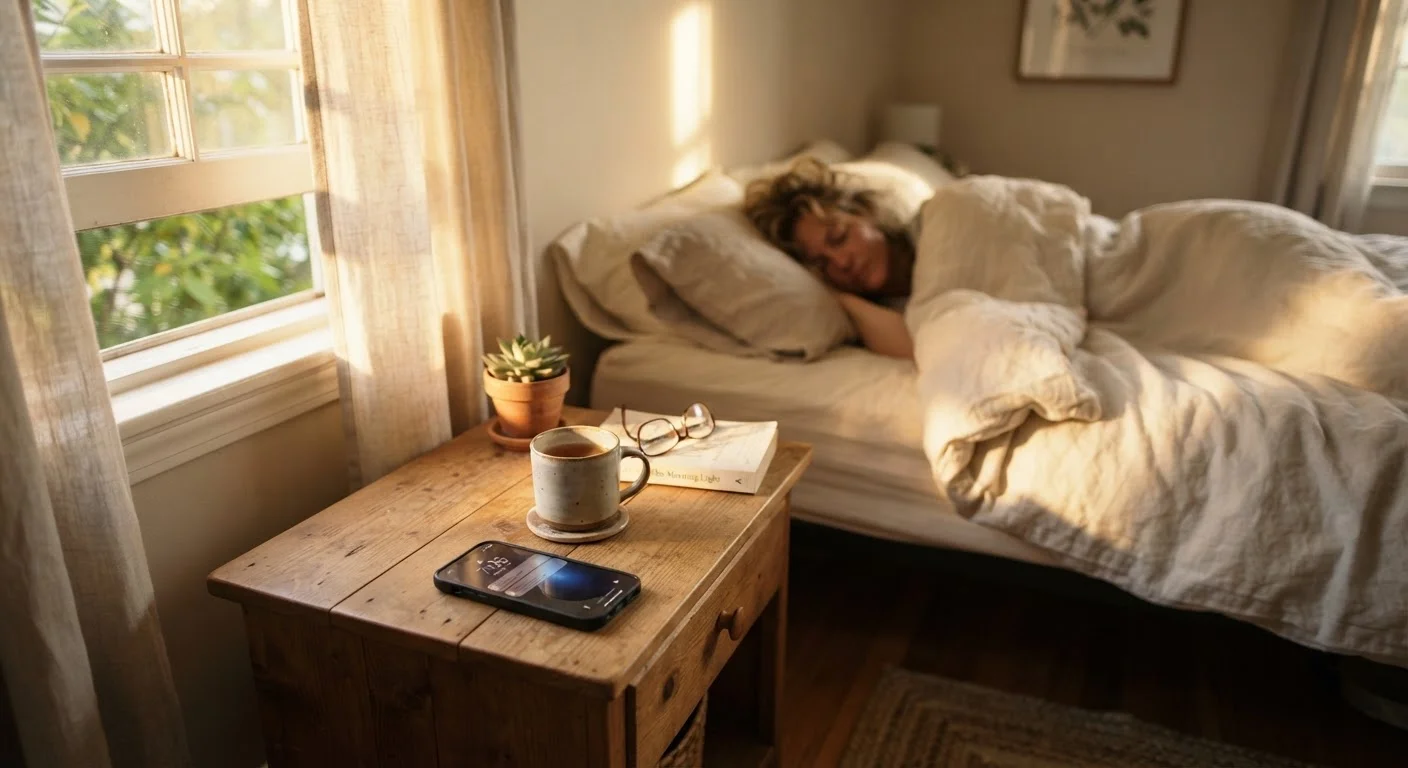
How Light Tells Your Brain What Time It Is
Every morning your eyes do more than help you see - they send time-of-day information straight to your brain. Specialized cells in the retina, called intrinsically photosensitive retinal ganglion cells (ipRGCs), are particularly sensitive to short-wavelength blue light. When activated by daylight, they signal the suprachiasmatic nucleus - your brain's master clock - to suppress melatonin and increase alertness. This is how your body knows it's time to be awake.
As evening approaches and light fades, that suppression lifts. Melatonin rises, your core body temperature drops, and you feel the pull toward sleep. This sequence isn't random - it's the product of millions of years of adaptation to the solar cycle. The problem is that modern life has introduced light sources that don't respect sundown.
Understanding this system is the foundation for everything else discussed in this article. For a broader look at how sleep quality affects your emotional health, see our complete overview of sleep and mental well-being.
~90%
Adults using screens within an hour of bed
A National Sleep Foundation poll found the large majority of American adults use an electronic device in the hour before trying to sleep.
~1 hour
Average sleep onset delay from evening screen exposure
Studies in sleep science literature suggest evening blue-light exposure can delay melatonin onset by roughly an hour in some participants.
10,000 lux
Typical outdoor light intensity on a sunny day
Indoor lighting averages 100-500 lux - making outdoor daylight dramatically more effective for circadian entrainment.
The Screen Problem: What Blue Light Actually Does
Smartphones, tablets, laptops, and televisions all emit light across the visible spectrum, with a notable concentration in the blue range - the very wavelengths most effective at suppressing melatonin. Using these devices in the hour or two before bed can delay your body's readiness for sleep, even if you feel tired.
Research published in journals such as the Journal of Clinical Sleep Medicine and PNAS has linked evening screen use with delayed sleep onset, reduced sleep duration, and poorer sleep quality the following day. The effect is dose-dependent: brighter screens held closer to the face have a stronger impact. Children and adolescents may be more sensitive, though disruption is documented across age groups.
It's worth noting that blue light isn't the whole story. Screen use is also mentally stimulating - social media, news, and video content can heighten arousal and make it harder to transition into the relaxed state sleep requires. The light and the content work together to keep your brain alert.
Try a Simple Evening Wind-Down Habit
About 60 to 90 minutes before bed, dim the lights in your home and set your devices to their lowest brightness setting. If you can, swap screen time for a low-stimulation activity like reading a physical book or gentle stretching. Small, consistent shifts like this are more sustainable than overnight overhauls.
Using Light Intentionally to Support Better Sleep
The good news is that light exposure is a lever you can adjust. Here are evidence-informed approaches:
- Get outdoor light in the morning. Even 10 to 20 minutes of natural light within an hour of waking helps anchor your circadian rhythm. Cloudy sky light still far exceeds typical indoor illumination.
- Keep your home bright during the day. Sitting near windows or spending time outdoors keeps your internal clock well-calibrated to the actual time of day.
- Dim your environment in the evening. Switching to warm, dim lighting 1 to 2 hours before bed signals your brain that night is approaching. This supports natural melatonin rise.
- Reduce screen brightness at night. Using night mode, lowering brightness manually, or stepping away from devices before sleep are all reasonable steps. Consistency matters more than perfection.
- Make your bedroom dark. Light pollution from streetlights or standby indicators can fragment sleep. Blackout curtains or an eye mask are simple interventions worth trying.
These habits don't exist in isolation - they're part of a broader set of practices covered in our sleep hygiene foundational guide. For room-specific changes, the bedroom environment audit offers a practical checklist. And if you're curious about how light shapes mood beyond sleep, see how food, movement, and light influence your daily mood.
Light, Hormones, and the Broader Picture
Your circadian rhythm doesn't just govern sleep - it coordinates the timing of cortisol, insulin, growth hormone, and other key hormones. When light exposure is chronically misaligned with your internal clock (a state sometimes called circadian misalignment), the effects can ripple outward into mood, metabolism, and immune function. This is why shift workers and frequent travelers often report more than just fatigue.
Melatonin in particular is tightly coupled to the light-dark cycle, and disruptions affect more than just sleep timing - they may influence hormonal patterns more broadly. For a deeper look at the relationship between sleep and hormonal health, see sleep, hormones, and the cycle they share.
“Light is the most powerful synchronizer of our internal clock to the external world. Getting that timing right - more light in the morning, less at night - is one of the most impactful things a person can do for their sleep and overall health.”
— Matthew Walker, Professor of Neuroscience and Psychology, University of California, Berkeley; author of research on sleep science
This article is for informational purposes only and is not a substitute for professional medical advice. If you have concerns about your sleep or health, please consult a qualified healthcare provider.