
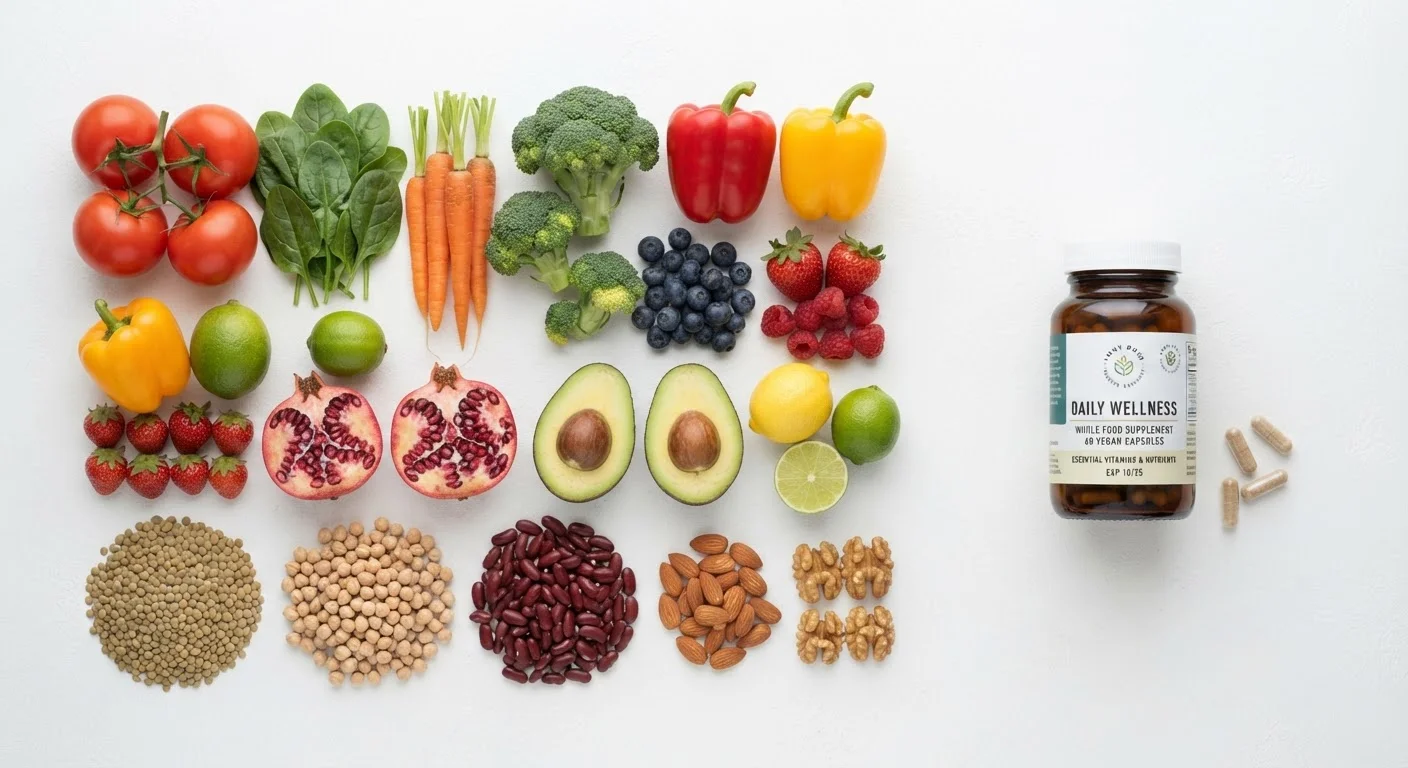
Why the Food vs. Supplement Question Matters
Walk into any pharmacy and you'll find hundreds of bottles promising to fill nutritional gaps. At the same time, public health guidance consistently points back to food. So which approach actually delivers? The honest answer is: it depends — on the nutrient, on your individual circumstances, and on what the research actually shows.
This article lays out a straightforward, evidence-informed comparison so you can think clearly about your own choices. It is general health information, not personal medical advice. If you're considering supplements, always discuss this with a qualified healthcare provider first.
For a deeper look at how whole foods and processed foods differ nutritionally, see what whole and processed foods really mean.
How Whole Foods Deliver Nutrients
Whole foods — vegetables, fruits, legumes, whole grains, nuts, seeds, and animal products in minimally processed forms — deliver nutrients within a complex biological matrix. This matters more than it might sound.
When you eat a carrot, for example, you're not just getting beta-carotene. You're also getting fiber, water, and dozens of phytochemicals (plant compounds) that influence how the beta-carotene is absorbed and used. This synergy between nutrients is sometimes called the food matrix effect, and it's a primary reason nutrition scientists tend to favor food-first approaches.
The NIH Office of Dietary Supplements notes that many nutrients in whole foods may have health benefits that isolated supplements haven't demonstrated in clinical trials. Fiber — abundant in plant foods and largely absent from most supplements — supports gut health, blood sugar regulation, and cardiovascular markers in ways that go beyond any single vitamin or mineral.
| Whole Foods | Dietary Supplements | |
|---|---|---|
| Nutrient complexity | Hundreds of compounds in natural matrix | Isolated or combined selected nutrients |
| Bioavailability | Often enhanced by food matrix synergy | Variable; can be high or low depending on form |
| Fiber content | Naturally present in plant foods | Absent in most supplements |
| Risk of overconsumption | Very low from food alone | Possible, especially fat-soluble vitamins and minerals |
| Evidence for chronic disease prevention | Strong, consistent research base | Mixed; few benefits beyond correcting deficiency |
| FDA pre-market oversight | Regulated as food | Not evaluated for safety/efficacy before sale |
| Best use case | Foundation of daily nutrition | Addressing confirmed deficiencies or special needs |
To understand common misconceptions that can steer people away from whole foods unnecessarily, see our article on nutrition myths that mislead beginners.
What Supplements Can and Cannot Do
Supplements — including vitamins, minerals, and botanical extracts in pill, powder, or liquid form — are useful tools under specific conditions. They are not a shortcut to good nutrition, but they do have a legitimate role in certain circumstances.
Where supplements have clear evidence:
- Folate before and during early pregnancy to reduce the risk of neural tube defects — a recommendation supported by the CDC and major obstetric bodies.
- Vitamin D for people with limited sun exposure, darker skin tones, or confirmed deficiency.
- Vitamin B12 for people following strict plant-based diets, since B12 is found almost exclusively in animal products.
- Iron when deficiency is confirmed by blood testing, particularly in menstruating individuals.
Where evidence is weaker: Large clinical trials — including long-running studies from institutions like Harvard and the NIH — have generally found that broad multivitamin use does not reduce the risk of major chronic diseases in people who are already eating adequately. Taking a supplement to compensate for a poor diet rarely produces the same outcome as improving the diet itself.
More Is Not Always Better With Supplements
Fat-soluble vitamins — A, D, E, and K — are stored in the body and can accumulate to toxic levels if taken in large amounts over time. Even water-soluble nutrients like vitamin B6 can cause nerve damage at very high supplemental doses. Never exceed the Tolerable Upper Intake Level (UL) set by the National Academies without explicit guidance from a healthcare provider. If you are pregnant, elderly, or managing a chronic condition, consult a professional before adding any supplement to your routine.
For a more detailed look at where supplement thinking goes wrong, see vitamin and mineral beliefs that science doesn't always support.
Key Differences at a Glance
57%
U.S. adults who use dietary supplements
According to CDC National Health and Nutrition Examination Survey data, more than half of American adults report taking at least one dietary supplement.
~$50B
Annual U.S. supplement market size
The dietary supplement industry generates roughly $50 billion annually in the United States, reflecting widespread consumer interest but not universal clinical need.
4
Fat-soluble vitamins that can accumulate toxically
Vitamins A, D, E, and K are stored in body fat and liver tissue; unlike water-soluble vitamins, excess intake from supplements can reach harmful levels over time.
One important practical distinction: the U.S. Food and Drug Administration (FDA) does not evaluate dietary supplements for safety or effectiveness before they reach shelves — unlike prescription medications. This means quality, potency, and purity can vary between products. Choosing supplements that have undergone third-party testing is generally advisable when supplementation is warranted.
Women navigating specific micronutrient questions may also find it useful to explore how women can think about nutritional gaps across food and supplement sources.
This article is for informational and educational purposes only and is not a substitute for professional medical advice, diagnosis, or treatment. Always consult a qualified healthcare provider before starting any supplement regimen.