
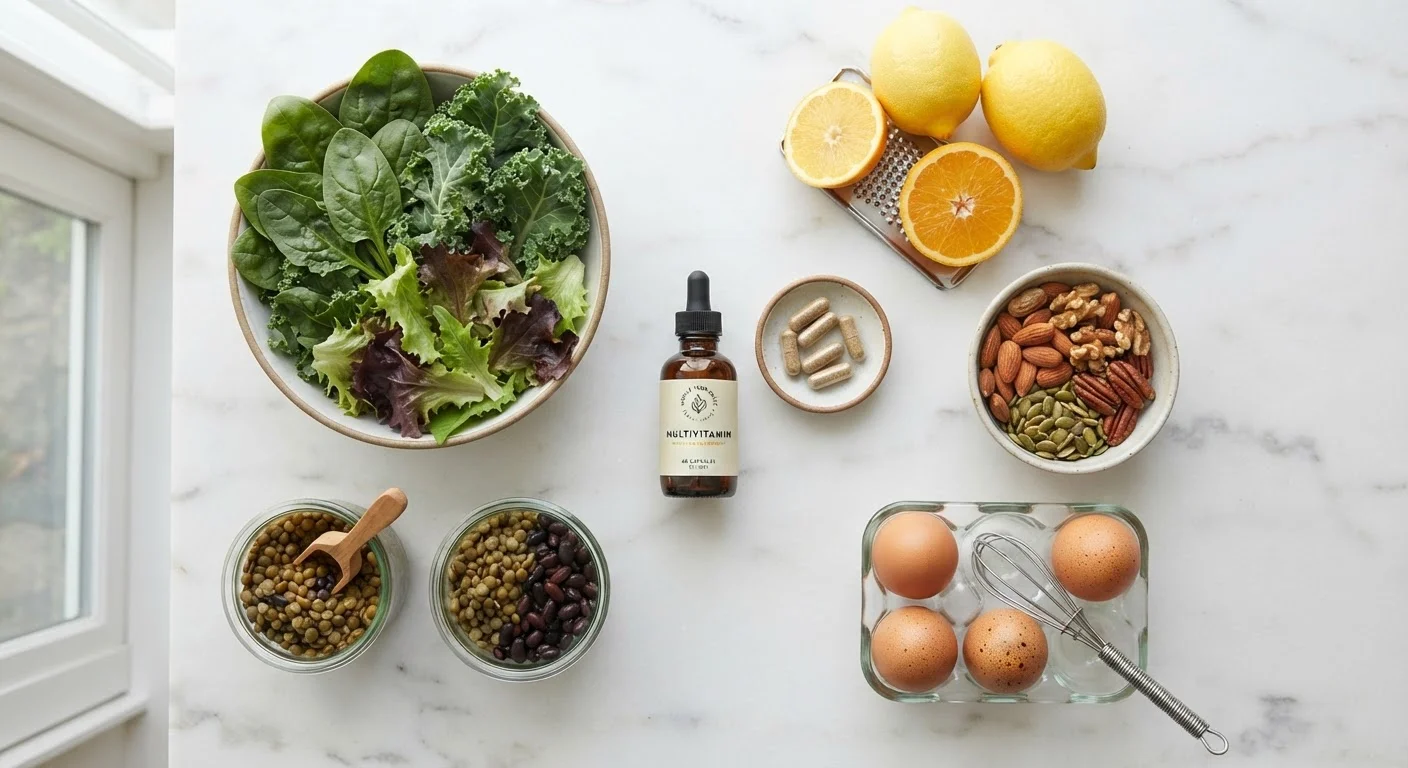
Why This Question Matters Specifically for Women
Women's nutritional needs are not simply a scaled-down version of men's. Hormonal fluctuations tied to the menstrual cycle, pregnancy, breastfeeding, and menopause create shifting demands for specific micronutrients — iron, folate, calcium, vitamin D, and magnesium among them. At the same time, the supplement industry presents an overwhelming range of products, often promising to fill gaps that may or may not exist.
Understanding how whole foods and supplements actually differ — and when each approach makes sense — helps women make choices grounded in evidence rather than marketing. For a broader comparison of how these two approaches behave in the body, see what the evidence suggests about food vs. supplements.
What Whole Foods Offer That Supplements Cannot
Whole foods — vegetables, legumes, whole grains, dairy, eggs, fish, and fruit — deliver nutrients within a complex biological matrix. That matrix matters. Nutrients in food interact with fiber, phytonutrients (plant compounds), and other vitamins and minerals in ways that affect how well the body absorbs and uses them. This is sometimes called the food synergy effect.
For example, vitamin C from bell peppers and citrus helps the body absorb non-heme iron (the plant-based form), while calcium and vitamin D work together in bone metabolism. A supplement providing either nutrient alone may not replicate these synergistic effects as efficiently.
Whole foods also deliver fiber and thousands of bioactive compounds that have been associated in research with reduced chronic disease risk. No supplement comprehensively captures this complexity. For a deeper look at what distinguishes whole foods from their processed counterparts, see what whole foods vs. processed foods actually means.
| Whole Foods | Dietary Supplements | |
|---|---|---|
| Nutrient delivery | Complex matrix with synergistic compounds | Isolated or combined nutrients, variable absorption |
| Bioavailability | Generally high; enhanced by food synergy | Varies widely by form and formulation |
| Additional health benefits | Fiber, antioxidants, phytonutrients included | Minimal — targeted nutrients only |
| Risk of excessive intake | Low; hard to overconsume from food alone | Possible; fat-soluble vitamins can accumulate |
| Addressing confirmed deficiency | May be insufficient for severe deficiencies | Effective when deficiency is confirmed and dose is appropriate |
| Regulatory oversight (US) | Standard food safety regulations apply | Less rigorous than prescription drugs; third-party testing varies |
| Best suited for | Everyday nutritional foundation for all women | Specific gaps, life-stage needs, or confirmed deficiencies |
When Supplements Fill a Genuine Gap
There are real circumstances in which diet alone consistently falls short for women — and where supplementation has clear, evidence-supported value.
- Folate before and during pregnancy: Neural tube development occurs very early in pregnancy, often before a woman knows she is pregnant. Public health guidance broadly supports folate or folic acid supplementation for women of reproductive age. For nuance on which form is right for you, see folate vs. folic acid for women.
- Iron: Menstruation increases iron losses; some women, particularly those with heavy periods or plant-forward diets, may struggle to meet needs through food alone.
- Vitamin D: Synthesized through sun exposure, vitamin D is difficult to obtain adequately from food. Deficiency is common, especially in northern latitudes and among those with limited sun exposure.
- Vitamin B12: Found almost exclusively in animal products; women following plant-based diets are at meaningful risk of deficiency over time. See plant-based eating and women's nutritional gaps for more context.
More Is Not Always Safer With Supplements
Fat-soluble vitamins — A, D, E, and K — are stored in the body rather than excreted, meaning they can accumulate to harmful levels with ongoing high-dose supplementation. Even water-soluble nutrients like vitamin B6 can cause nerve-related symptoms at chronically elevated doses. Self-prescribing high-dose supplements without confirmed need or professional oversight carries real risk. Always seek guidance from a healthcare provider before adding high-dose supplements to your routine.
The key word here is genuine. Supplementing without knowing whether a deficiency exists can lead to excessive intake of certain nutrients, some of which become harmful at high doses. Blood testing ordered by a healthcare provider is the most reliable way to identify real gaps before reaching for a pill.
For a fuller look at flawed thinking around vitamins and minerals, common supplement misconceptions worth questioning is a useful resource.
Making a Practical Decision for Your Own Needs
Rather than choosing one approach over the other categorically, most women benefit from thinking about nutrition in two layers: a strong food foundation, and targeted supplementation only where evidence and personal circumstances justify it.
~42%
US adults estimated to be vitamin D deficient
Research published in Nutrition Research estimated that approximately 42% of US adults have insufficient vitamin D levels, with higher rates among certain demographic groups.
~10%
US women of reproductive age with iron deficiency
The CDC has estimated that roughly 10% of women of reproductive age in the US have iron deficiency, making it one of the most common nutritional shortfalls in this group.
Start by evaluating your diet honestly. Are there entire food groups consistently missing? Are you in a life stage — pregnancy, perimenopause, postmenopause — with elevated demands? Have you had blood work done recently? These questions matter more than any general supplement recommendation.
When supplementation does make sense, quality and dosage matter. The supplement industry in the US is not regulated with the same rigor as prescription medications. Look for products that have undergone third-party testing for purity and potency, and always follow dosage guidance from a qualified healthcare provider rather than the maximum listed on a label.
For a strong overview of the core nutrients every woman's body needs daily, the essential nutrients hub provides clear foundational information. And if you want to understand the broader case for food-first thinking, see the case for getting nutrients from food.
This article is for general informational and educational purposes only and does not constitute medical advice. Always consult a qualified healthcare provider before starting, stopping, or changing any supplement regimen, especially during pregnancy, breastfeeding, or if you have an underlying health condition.