
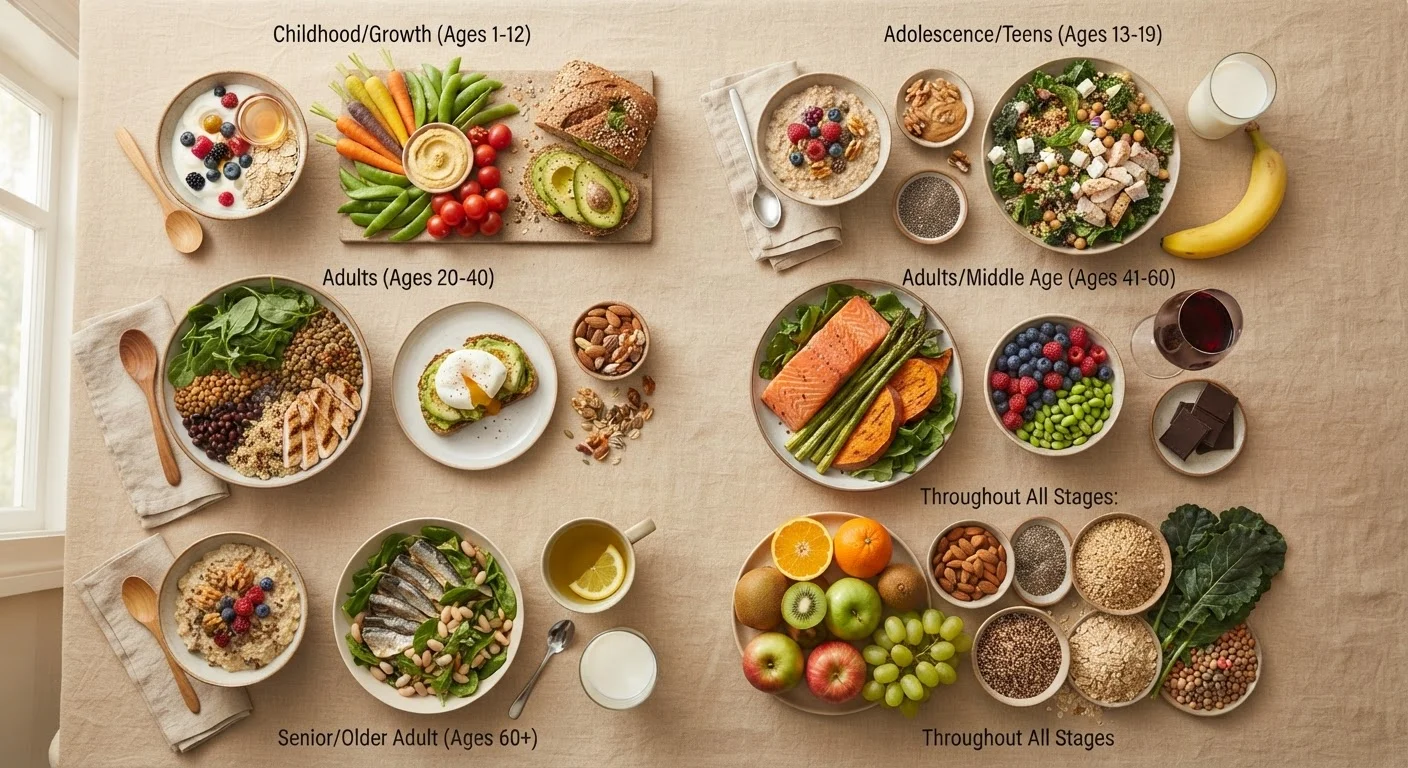
Why Women's Nutrition Isn't One-Size-Fits-All
Hormonal fluctuations, reproductive milestones, and metabolic shifts mean that the nutrients your body most needs at 25 look quite different from what it needs at 55. Yet most general nutrition guidance is written without women's distinct biology in mind. This checklist distills the science into decade-by-decade priorities so you can audit your habits at any stage.
For a deeper look at the science behind these changes, see why women's nutritional needs change across a lifetime. And if you're curious how these patterns compare with aging in men, nutrition across every stage of adulthood offers useful context for both sexes.
This article is for general health information only and is not a substitute for personalized medical or dietary advice. Please consult a qualified healthcare provider or registered dietitian before making significant changes to your diet.
Registered Dietitian (RD or RDN)
A registered dietitian can translate general decade-based guidelines into a personalized eating plan that accounts for your health history, medications, and goals.
Food and symptom journal
Tracking meals, energy, and symptoms for one to two weeks helps identify nutritional gaps and patterns before a dietitian or provider appointment.
Routine blood panel
A standard panel ordered by your healthcare provider can reveal deficiencies in iron, vitamin D, B12, and other markers relevant to your life stage.
Nutrient tracking app
A reputable nutrient-tracking app can give a rough picture of daily micronutrient intake — useful for spotting consistent shortfalls in iron, calcium, or fiber.
Your Decade-by-Decade Nutrition Checklist
Work through the groups below that apply to your current life stage — or use the full checklist to understand how your needs will evolve over time. Keep in mind that these are population-level patterns; individual variation is real and significant. For guidance specific to reproductive wellness at each stage, reproductive health across the decades is a helpful companion read.
In Your 20s: Build the Foundation
In Your 30s: Support Energy, Fertility, and Recovery
In Your 40s: Prepare for Hormonal Transition
In Your 50s and Beyond: Protect Muscle, Bone, and Brain
Supplementation Is Not a Substitute for Medical Guidance
Many nutrients mentioned in this checklist are available as supplements, but more is not always better — some vitamins and minerals can be harmful in excess. Never start a new supplement regimen without first discussing it with your healthcare provider, who can assess your actual levels and individual needs. This is especially important during pregnancy, breastfeeding, or if you take prescription medications.
Putting the Checklist Into Practice
Reviewing priorities is only half the work — the other half is translating them into grocery runs and meals. A consistent weekly shopping routine makes it far easier to meet shifting nutrient targets without relying on willpower alone. Our practical week of mindful grocery shopping guide can help you build a cart that reflects your decade's priorities.
For women approaching perimenopause or navigating menopause, dietary needs shift in particularly nuanced ways. Navigating nutrition through perimenopause and menopause explores those considerations in depth. Whatever your stage, the healthy eating habits hub offers ongoing practical guidance to support long-term wellness.
Restrictive Dieting Can Backfire at Every Age
Severe calorie restriction or eliminating entire food groups without medical supervision can worsen nutrient deficiencies that are already common across women's life stages. If you're considering a significant dietary change — such as going fully plant-based or following an elimination protocol — consult a registered dietitian to ensure your micronutrient needs are still met. Disordered eating patterns can emerge or re-emerge at any age; please seek support if eating feels distressing.