
What Is the Hormonal Cycle?
Your menstrual cycle is far more than a monthly bleed — it's a carefully orchestrated hormonal process that repeats throughout your reproductive years. Controlled by a dialogue between your brain and ovaries, it prepares your body for the possibility of pregnancy each month, whether or not that's your goal.
Understanding this cycle isn't just useful for family planning. It helps explain why you might feel energised and focused one week, and more introspective or tired the next. See our breakdown of each menstrual phase for a companion look at what's physically happening at each stage.
Menstrual cycle
The monthly hormonal process that prepares the uterus for potential pregnancy and resets if conception doesn't occur. It's counted from the first day of one period to the first day of the next.
Oestrogen
A primary female sex hormone produced mainly by the ovaries. It builds the uterine lining, supports bone density, and influences mood and energy.
Progesterone
A hormone released after ovulation that stabilises the uterine lining. It has a calming, sleep-supportive effect and drops sharply before menstruation begins.
Ovulation
The release of a mature egg from the ovary, typically occurring around the midpoint of the cycle. It's triggered by a surge in luteinising hormone (LH).
Luteal phase
The second half of the menstrual cycle, after ovulation. It's dominated by progesterone and is when premenstrual symptoms, if any, typically occur.
Hormonal imbalance
A state in which one or more hormones are produced at levels outside their expected range, which can affect mood, energy, periods, and overall wellbeing.
The Key Hormones Involved
Four hormones do most of the coordinating work:
- Oestrogen — Produced mainly by the ovaries, it builds the uterine lining and influences mood, bone density, and skin health.
- Progesterone — Released after ovulation, it stabilises the uterine lining and has a calming, sleep-promoting effect on many women.
- Follicle-Stimulating Hormone (FSH) — Produced by the pituitary gland, it signals follicles in the ovaries to mature and produce oestrogen.
- Luteinising Hormone (LH) — Also from the pituitary, its surge triggers ovulation.
For a deeper look at what each hormone specifically does in a woman's body, see our article on oestrogen, progesterone, and testosterone.
How Hormones Shift Across the Four Phases
Each phase of the cycle has a distinct hormonal fingerprint:
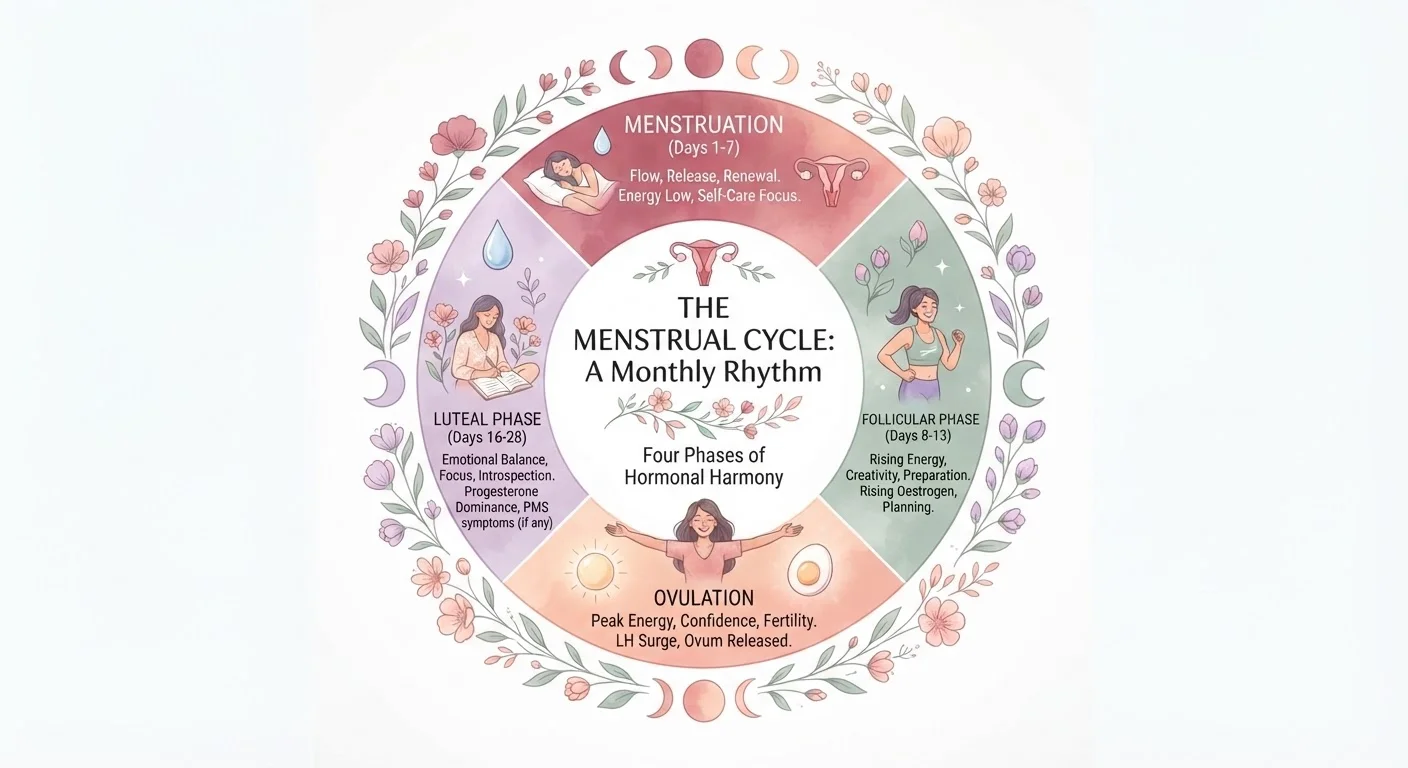
- Menstrual phase (Days 1–5 approx.): Oestrogen and progesterone are at their lowest, prompting the uterine lining to shed. Many women notice lower energy during this time.
- Follicular phase (Days 1–13 approx.): FSH rises, stimulating follicle development. Oestrogen climbs steadily, often lifting mood and boosting concentration. This phase overlaps with menstruation at its start.
- Ovulatory phase (Around Day 14): A sharp LH surge triggers the release of a mature egg. Oestrogen peaks briefly; some women feel most energised and sociable at this point.
- Luteal phase (Days 15–28 approx.): The ruptured follicle becomes the corpus luteum and releases progesterone. If pregnancy doesn't occur, both hormones decline sharply — a drop that can contribute to premenstrual symptoms in some women.
These hormonal shifts have a direct knock-on effect on daily energy. Learn more in our guide on why energy levels change throughout the month.
Track Your Cycle to Spot Patterns
Keeping a simple log of your cycle — noting the start and end of your period, energy levels, and mood — over two to three months can reveal meaningful patterns. This information is also invaluable to share with a healthcare provider if you have concerns. Many period-tracking apps can help you get started.
What Hormonal Imbalance Can Look Like
Hormonal imbalances occur when one or more hormones fall outside their expected ranges or don't follow the usual pattern across the cycle. This is more common than many people realise and has a wide range of causes — stress, thyroid conditions, polycystic ovary syndrome (PCOS), perimenopause, and others.
Possible signs include:
- Irregular, absent, or unusually heavy periods
- Persistent fatigue unrelated to sleep
- Significant premenstrual mood changes or anxiety
- Skin changes such as adult acne or increased oiliness
- Difficulty maintaining a healthy weight without dietary changes
Don't Dismiss Persistent Symptoms
It can be tempting to attribute mood swings, fatigue, or cycle irregularities to stress alone. While stress is a genuine factor, persistent or severe symptoms deserve professional evaluation. Conditions like PCOS, thyroid disorders, and endometriosis are treatable — but only once properly diagnosed.
These symptoms overlap with many conditions. A healthcare provider can run hormonal blood panels and assess the full picture — self-diagnosing based on symptoms alone is rarely reliable.
Supporting Your Hormonal Health
While no lifestyle change can override a clinical hormonal condition, daily habits do interact meaningfully with the hormonal system. Research suggests that adequate sleep, balanced nutrition, and stress management each support the body's ability to regulate hormones effectively.
Sleep, in particular, has a two-way relationship with hormonal health — disrupted sleep can worsen hormonal irregularities, and hormonal changes can disrupt sleep. Explore this further in our article on sleep and the hormonal cycle.
Dietary patterns also play a role. Emerging evidence suggests that eating in ways that support stable blood sugar and reduce inflammation may benefit hormonal balance. See nutrition patterns for hormonal balance for what the current research shows.
If you're noticing symptoms that concern you, the most effective step is to speak with a qualified healthcare provider. Hormonal health is deeply individual — and expert guidance makes all the difference.
This article is for informational purposes only and is not a substitute for professional medical advice, diagnosis, or treatment. Always consult a qualified healthcare provider with any questions you have regarding your health or a medical condition.