
Why Understanding Your Cycle Matters
For many women, the menstrual cycle is treated as a monthly inconvenience rather than a window into their overall health. But your cycle is far more than just your period — it's a dynamic, four-phase biological process driven by shifting hormones that affect your mood, energy, digestion, skin, and sleep every single month.
Learning what each phase actually does gives you context for the changes you feel throughout the month, and helps you recognize when something might warrant a conversation with your healthcare provider. For a deeper look at the hormones involved, see what estrogen, progesterone, and testosterone each do in the female body.
21–35 days
Normal menstrual cycle length range
According to the American College of Obstetricians and Gynecologists, a healthy cycle can range from 21 to 35 days — meaning the commonly cited 28-day average applies to far fewer people than assumed.
~12–24 hours
Window an egg remains viable after ovulation
Research in reproductive medicine confirms a mature egg can be fertilized for only roughly 12 to 24 hours after release, making the timing of ovulation critical for conception planning.
Up to 90%
Of reproductive-age women report PMS symptoms
Studies estimate that up to 90% of women experience at least some premenstrual symptoms, though clinically significant PMS affects a smaller proportion, and severe PMDD affects an estimated 3–8%.
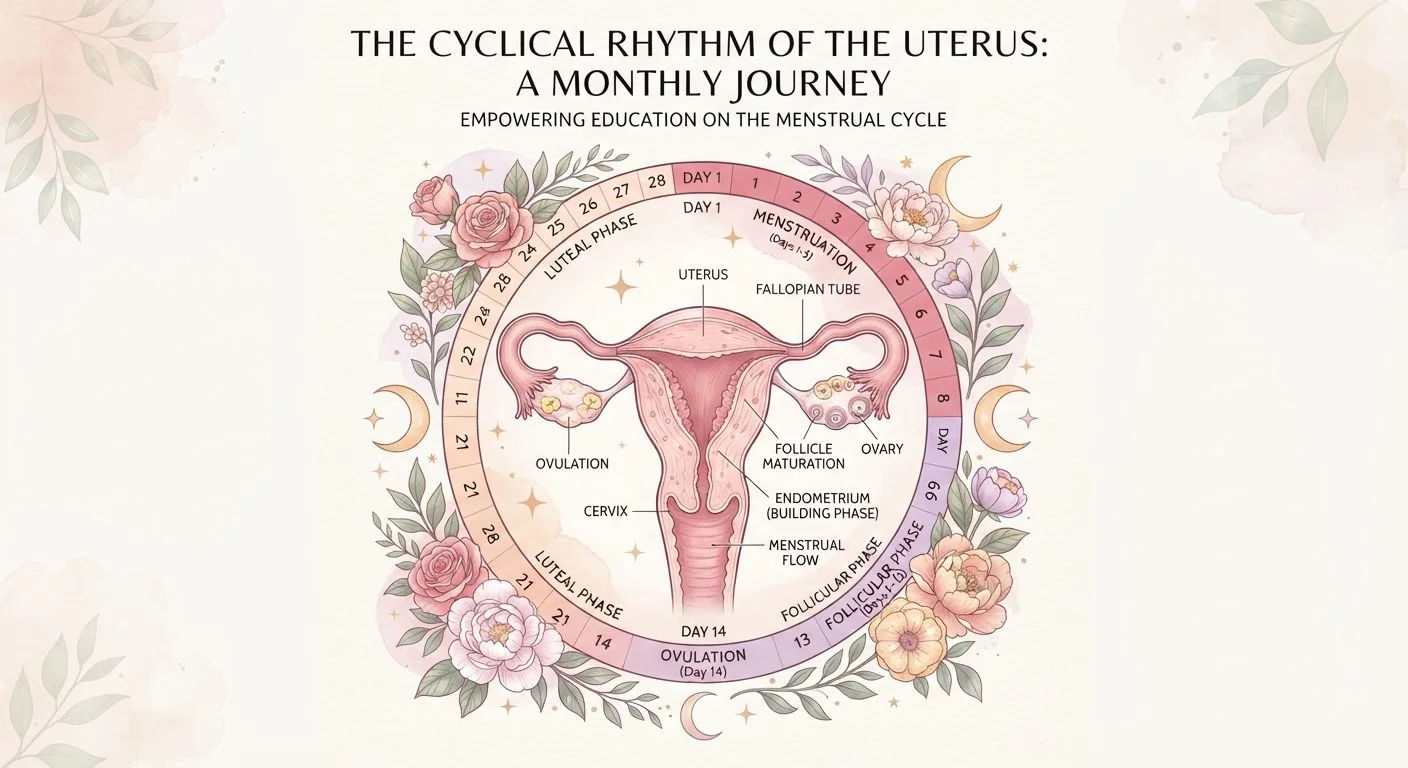
Phase 1: Menstrual Phase (Days 1–5, Approximately)
Your cycle officially begins on Day 1 — the first day of full menstrual flow. This phase occurs because the previous cycle did not result in pregnancy: estrogen and progesterone levels drop sharply, signaling the uterus to shed its lining (the endometrium). This shedding is what you experience as your period.
Menstrual flow typically lasts three to seven days. Many people experience cramping during this time, caused by prostaglandins — hormone-like compounds that trigger uterine muscle contractions to help expel the lining. Fatigue and lower energy are also common as both hormone levels are at their lowest point. These symptoms are normal, though severe pain (dysmenorrhea) is worth discussing with a provider.
Phase 2: Follicular Phase (Days 1–13, Approximately)
The follicular phase actually overlaps with menstruation — it begins on Day 1 and continues until ovulation. During this phase, the pituitary gland releases follicle-stimulating hormone (FSH), which prompts several follicles in the ovaries to begin maturing. Each follicle contains an egg. Typically, one dominant follicle emerges and continues developing while the others are reabsorbed.
As the follicles grow, they produce increasing amounts of estrogen. Rising estrogen thickens the uterine lining in preparation for a potential fertilized egg. Many people notice improved mood, mental sharpness, and physical energy during this phase — effects that are directly tied to climbing estrogen levels. To understand why estrogen has this effect, explore the female hormonal cycle explained.
Notice Your Energy Patterns Each Phase
Many women find it helpful to keep a simple daily journal noting energy, mood, and physical sensations throughout the month. Over two or three cycles, patterns often emerge that map closely onto the four phases. This self-knowledge can help you work with your body's natural rhythms rather than against them — and gives you useful information to share with a healthcare provider if concerns arise.
Phase 3: Ovulatory Phase (Around Day 14)
Ovulation is the main event of the cycle. A surge in luteinizing hormone (LH) triggers the dominant follicle to rupture and release a mature egg, which travels down the fallopian tube toward the uterus. The egg is viable for fertilization for roughly 12 to 24 hours, though sperm can survive for several days in the reproductive tract.
Many people feel their best physically during ovulation — energy peaks, libido often increases, and some notice a subtle rise in body temperature. Mild one-sided pelvic discomfort around ovulation, known as mittelschmerz, is common and typically brief. Pinpointing ovulation is important for both conception and contraception planning. See how to track your cycle effectively for practical methods.
Phase 4: Luteal Phase (Days 15–28, Approximately)
After ovulation, the ruptured follicle transforms into a temporary structure called the corpus luteum, which secretes progesterone (and some estrogen). Progesterone's job is to maintain and further thicken the uterine lining in case a fertilized egg needs to implant.
If fertilization does not occur, the corpus luteum breaks down after about 10 to 14 days, progesterone and estrogen levels fall, and the cycle restarts with menstruation. This hormonal drop in the late luteal phase is what drives classic premenstrual syndrome (PMS) symptoms: bloating, breast tenderness, mood changes, irritability, and fatigue. These are genuine physiological responses — not imagined, and not inevitable for everyone.
What you eat during this phase may influence how you feel. Research in this area is evolving; for a balanced look at the evidence, see nutrition patterns that support hormonal balance.
When to Talk to a Healthcare Provider
Cycle irregularity is common, but certain patterns are worth a professional evaluation. These include cycles consistently shorter than 21 days or longer than 35, very heavy or prolonged bleeding, periods that stop for three or more cycles outside of pregnancy, and severe pain that disrupts daily life.
Conditions such as polycystic ovary syndrome (PCOS), endometriosis, thyroid dysfunction, and hypothalamic amenorrhea can all manifest through cycle changes. Early identification makes a meaningful difference in management. Your cycle is a health indicator — treat it as one.
You can explore more about how hormones connect to these broader patterns at the Hormonal Health hub.
This article is for general informational and educational purposes only and does not constitute medical advice. Always consult a qualified healthcare provider for guidance specific to your health needs.