
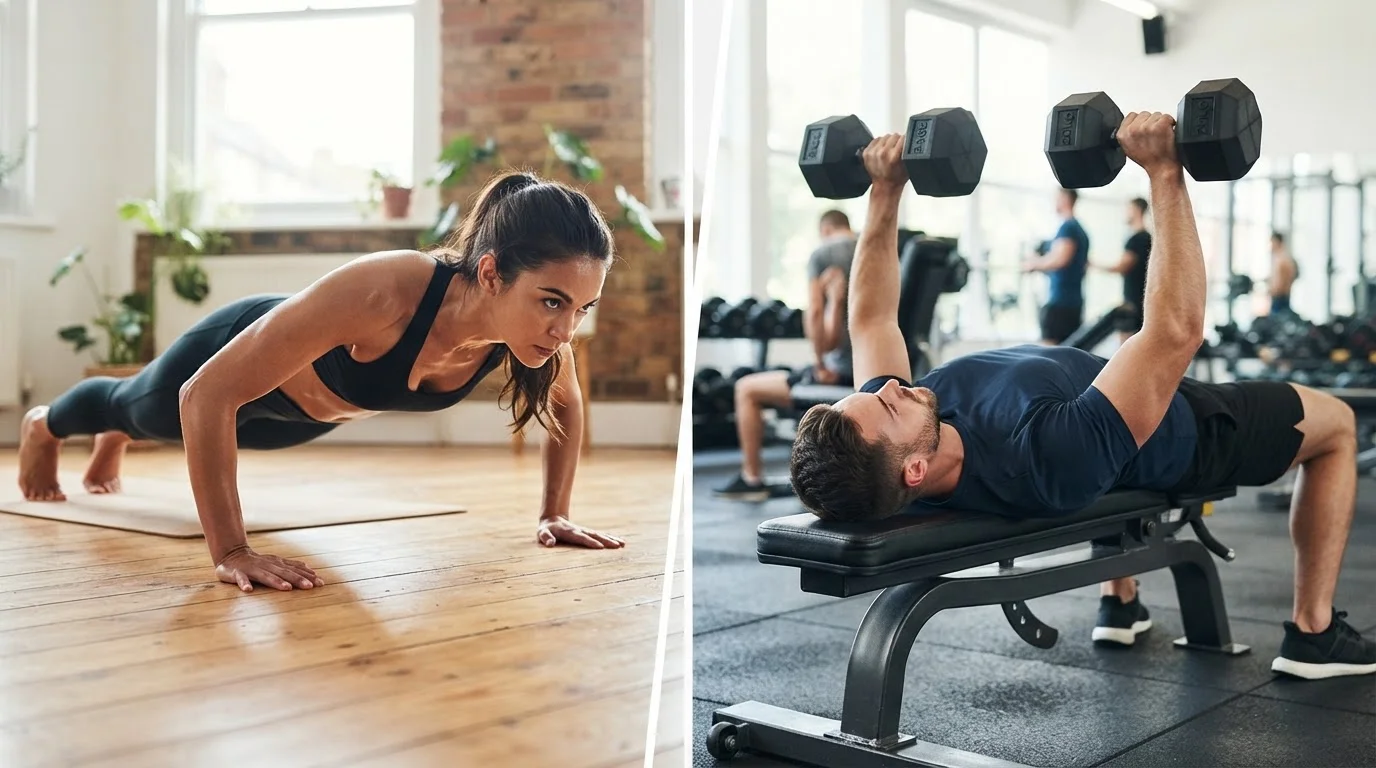
The Shared Foundation: How Both Methods Build Strength
Regardless of whether you're doing push-ups in your living room or pressing a barbell at the gym, your muscles respond to resistance - not to the source of it. Both bodyweight and weighted exercise trigger the same internal process: your muscle fibres experience stress, sustain microscopic damage, and then repair slightly stronger than before.
This is the principle of progressive overload - gradually increasing the challenge placed on your muscles over time. Understanding this is key to getting results from either method. To learn more about what's happening inside your muscles during this process, see our in-depth guide to strength training science.
Both approaches also improve muscular endurance, support bone density, and enhance functional movement - meaning they help you move better in daily life. These benefits don't belong exclusively to one method.
Where the Two Approaches Diverge
The meaningful differences between bodyweight and weighted training come down to load control, scalability, and accessibility.
| Bodyweight Training | Weighted Exercise | |
|---|---|---|
| Equipment needed | None | Dumbbells, barbells, or machines |
| Cost to start | Free | Gym membership or equipment purchase |
| Load control | Adjusted via leverage and variation | Precise incremental increases |
| Scalability for beginners | High - many entry-level options | High - start with light weights |
| Muscle-building potential | Effective, especially early on | Strong, particularly for advanced stages |
| Portability | Fully portable, train anywhere | Location-dependent |
| Learning curve | Low to moderate | Moderate - technique matters |
With weighted exercise - whether free weights or machines - you can increase resistance in precise increments. Add five pounds, track the change, and repeat. This measurability makes it easier to apply progressive overload in a structured way, which can be particularly useful as intermediate and advanced exercisers push past plateaus. If you're weighing your equipment options further, our article on free weights vs. machines breaks down that specific trade-off.
Bodyweight training scales differently. You increase difficulty by changing leverage, range of motion, or exercise variation - for example, progressing from a standard push-up to an archer push-up or a single-arm variation. This approach requires more creativity but no financial investment.
For a focused comparison of bodyweight exercise against gym equipment specifically for newcomers, see bodyweight vs. gym machines for beginners.
Practical Considerations for Beginners
If you're just starting out, the most important factor is often consistency - and consistency depends on removing friction. Ask yourself honestly: what will you actually do?
Start With What You'll Stick To
Research consistently shows that the workout you'll actually do beats the theoretically optimal one you won't. If bodyweight training at home means you exercise three times a week instead of zero, that is the better programme for you right now. Progress toward a gym or equipment later once the habit is established.
Bodyweight training has the lowest barrier to entry. No membership, no travel time, no cost. If structure and accountability matter more to you, a gym environment with weighted equipment - or even a group class - may keep you more engaged. Our comparison of group classes vs. solo training can help you think through which environment suits your personality.
If you're working at home and want a practical starting framework, our guide to building a home workout routine without equipment walks you through a structured plan using only your bodyweight.
It's also worth understanding how strength training fits within the broader landscape of exercise types. Bodyweight and weighted training are both primarily anaerobic in nature - they rely on short bursts of muscular effort rather than sustained cardiovascular output. Our explainer on aerobic vs. anaerobic exercise covers that distinction clearly.
This article is for general informational purposes only and does not constitute medical or personal training advice. Consult a qualified healthcare or fitness professional before beginning any new exercise programme, especially if you have an existing health condition or injury.